




19th November 2026
Hydraulic Fitting Types: A Practical OEM Selection Guide
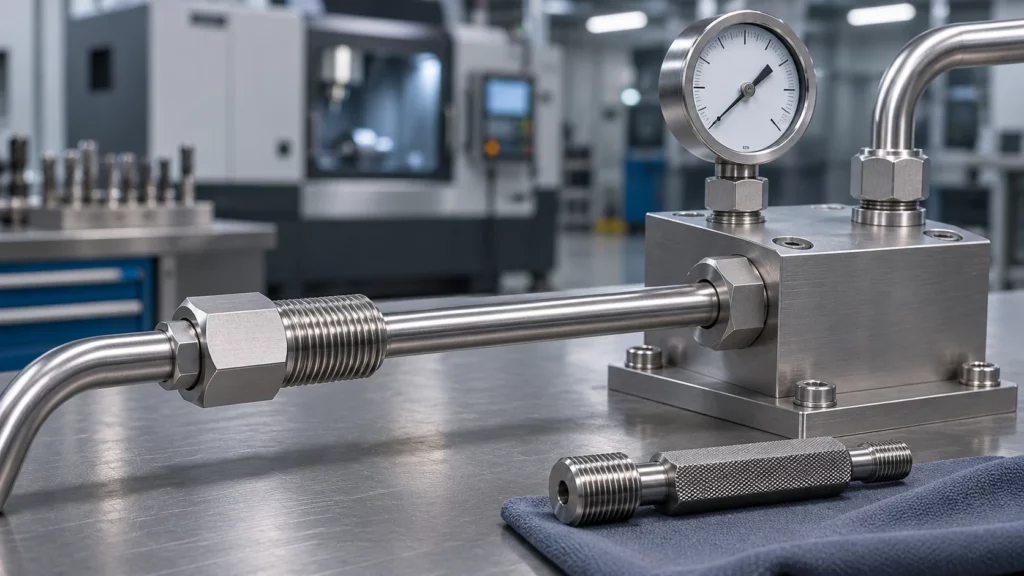
Hydraulic fitting types are often identified by a familiar label—JIC, ORFS, NPT, BSP, metric, or compression—but the label alone is not enough for a safe purchasing decision. A correct fitting must match the thread, sealing interface, tube or hose connection, material, pressure range, fluid, temperature, and installation method. For OEM buyers, the practical goal is not to memorize every catalog family. It is to create a repeatable identification and specification process that prevents mismatched parts, damaged sealing surfaces, unplanned rework, and field leakage.
This guide explains the main connection families and the questions that should appear on a drawing or request for quotation. It also shows where a custom machined fitting can make sense when envelope, material, geometry, or interface requirements fall outside a standard catalog part. CK Metal Tech manufactures custom stainless steel hydraulic fittings from bar stock, including threaded and ferrule-type designs in 304 or 316L stainless steel, subject to drawing review and application validation.
Start with the Seal, Not Just the Thread
A thread may pull two components together without being the surface that actually contains pressure. Some connections seal on a metal flare, some on an O-ring face, some on a bonded seal or washer, and some on tapered threads. Confusing the retention thread with the sealing method is a common source of identification errors. Before selecting a replacement, determine where sealing occurs and whether the joint is intended to be reusable.
Thread diameter and pitch can appear similar across standards while the seat angle, nose shape, or seal location differs. Two parts may begin to engage and still be incompatible. Confirm the complete connection with a drawing, approved identification tool, or qualified technical reference.
Common Hydraulic Fitting Types
37-Degree Flare Connections
A 37-degree flare connection uses matching metal seats to form the primary seal. It is common in mobile and industrial hydraulic systems and is valued for a compact, serviceable joint. Buyers should verify the thread, seat angle, tube or hose-end configuration, and material. A damaged or mismatched seat can leak even when the nut tightens normally.
O-Ring Face Seal Connections
An O-ring face seal connection places an elastomer in a groove at the face of the fitting. The flat mating face compresses the seal, which can provide robust performance where vibration and pressure cycling are concerns. Selection depends on face geometry, O-ring size and compound, thread, fluid compatibility, temperature, and cleanliness. The O-ring should be treated as a specified component, not an interchangeable accessory.
Tapered Pipe Threads
NPT and related tapered pipe connections seal through controlled thread interference, normally with an approved sealant for the application. They are familiar and widely available, but assembly technique affects orientation and sealing. Over-tightening can distort threads or a port, while under-tightening can leave a leak path. A buyer should distinguish tapered from parallel threads before measuring pitch.
Parallel Threads, Metric Cones, and Ferrule Connections
BSPP and other parallel-thread connections generally rely on a separate sealing feature rather than thread taper. Metric hydraulic families may use cone seats, O-rings, or cutting-ring arrangements. Ferrule or compression connections use one or more formed elements to grip tubing and create a seal. These families must be identified as complete interfaces: thread, seat, tube size, seal, and assembly method all belong in the specification.
How to Identify an Existing Hydraulic Fitting
Identification should begin only after the system has been isolated, depressurized, and made safe under the facility’s approved procedure. Clean the part so the thread and sealing surfaces are visible, then record the connection without relying on a single dimension.
- Determine whether the thread is straight or tapered and whether it is external or internal.
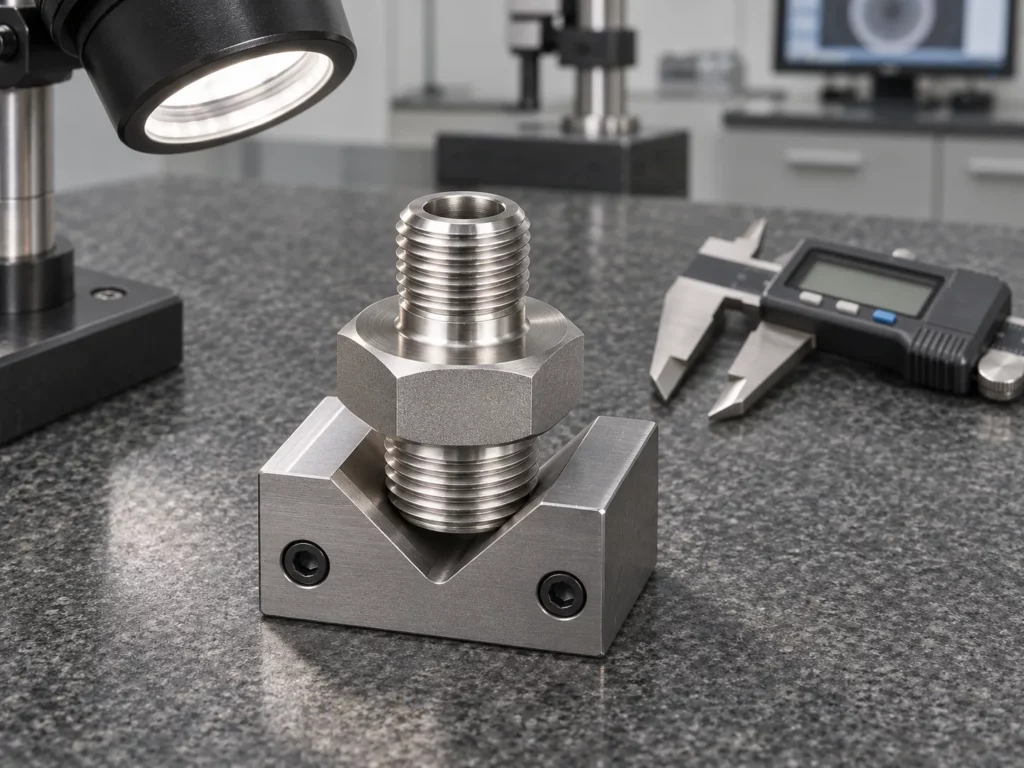
- For an external thread, measure across opposite crests with the outside jaws of a caliper to obtain the major diameter.
- For an internal thread, measure across opposite crests with the inside jaws to obtain the minor diameter. Check pitch with a thread gauge and compare the reading with the matching male or female identification table. For tapered threads, take the diameter at the position specified in that guide.
- Inspect the sealing location: thread, flare, cone, face O-ring, bonded seal, or ferrule.
- Record the tube or hose size, port orientation, hex dimensions, and installation envelope.
- Confirm material, surface treatment, fluid, temperature, working pressure, pressure transients, and vibration.
- Compare the results with the mating component and the approved assembly drawing before ordering.
Photographs can support screening but cannot reliably confirm pitch, seat angle, or seal dimensions. For reverse-engineered parts, provide the mating component, a controlled sample, or complete dimensional data and identify any requirements that still need customer approval.
Material and Surface Treatment: Why 304 or 316L Matters
Material selection should follow the fluid, external environment, cleaning chemistry, temperature, strength requirement, and contamination risk. Carbon steel can be economical when an appropriate protective finish is acceptable. Brass can suit selected low- or moderate-pressure fluid applications. Stainless steel is often considered for corrosive, hygienic, marine, food-equipment, or high-temperature environments, but the alloy still must be checked against the actual media and duty cycle.
For a custom stainless fitting, 304 offers broad corrosion resistance and manufacturing practicality, while 316L is often selected when additional resistance to chloride-bearing or chemically demanding environments is required. That comparison is application-dependent; it does not replace a corrosion review. Pickling and passivation can remove manufacturing contamination and support the stainless surface, provided the process and acceptance criteria are defined.
Pressure, Temperature, Fluid, and Installation Conditions
Pressure capability belongs to an assembly, not to a material name alone. Geometry, wall thickness, thread engagement, sealing design, manufacturing quality, mating parts, temperature, loading, and installation all influence performance. Working pressure, proof or validation requirements, impulse cycles, and any transient peaks should be stated separately. Do not infer a rating from a visually similar fitting.
Fluid compatibility must include the metal, elastomer, and sealant. Temperature, misaligned tubing, unsupported hose, vibration, and repeated assembly can alter joint performance. State the installation orientation and approved assembly procedure when they affect the interface.
Manufacturing Features That Affect Sealing Quality
Custom fitting quality depends on more than outside dimensions. Thread form, pitch diameter, sealing-face finish, cone angle, concentricity, edge breaks, and burr control can influence assembly and leakage risk. Inspection should prioritize the characteristics that create the seal, and internal passages should be free of loose contamination.
CK Metal Tech's Präzisionsbearbeitungsmöglichkeiten include CNC turning and milling, thread rolling, and grinding resources. A typical stainless fitting route may include bar-stock turning, threading, deburring, pickling, and passivation. The final route should be selected from the part geometry, tolerances, volume, traceability needs, and customer-approved control plan.
What to Include in an OEM Fitting RFQ
A useful RFQ identifies the connection standard or supplies the full interface dimensions, material grade, heat-treatment or surface requirements, annual volume, lot size, critical characteristics, inspection level, cleanliness, marking, packaging, and traceability. Include the operating fluid, temperature range, working and transient pressures, validation responsibility, mating-part details, and any regulatory or customer-specific requirements. If the part is being localized, identify whether the supplier may optimize non-interface geometry or must reproduce every feature.
Distinguish a standard purchasable component from a genuinely custom part. Review the broader precision metal component portfolio, then compare the proposed fitting with the approved system design. The supplier can verify producibility and inspection; application approval remains with the OEM or system owner unless another scope is agreed.
Abschluss
Selecting among hydraulic fitting types begins with the complete sealing interface, not the thread name. Identify the thread, seal, mating geometry, connection, material, and operating conditions as one system. Then control the manufacturing and inspection features that protect the interface.
Häufig gestellte Fragen
Can two hydraulic fittings with similar threads be connected?
No. Similar diameter and pitch do not confirm the same thread standard, seat geometry, or sealing method. Verify the complete interface before assembly.
Does stainless steel automatically provide a higher pressure rating?
No. Pressure capability depends on design, dimensions, material condition, mating parts, temperature, and validation. Stainless steel may be selected for corrosion resistance without changing the system rating.
What information is needed to quote a custom hydraulic fitting?
Provide a controlled drawing or full interface dimensions, material, quantity, tolerances, finish, operating conditions, inspection, mating-part details, and validation expectations. A sample alone may not define every requirement.
When should an OEM consider a custom fitting?
Consider customization when a standard part cannot meet the envelope, routing, material, connection, or supply requirement. Evaluate setup, qualification, volume, and lifecycle demand together.
Discuss a Custom Fitting Requirement
For a controlled drawing, mating specification, or existing fitting that needs manufacturability review, Kontaktieren Sie CK Metal Tech with the application conditions and quantities. The team can review the machining route, materials, inspection focus, and missing RFQ information.
Hinterlasse eine Antwort