







3rd September 2026
CNC Machining RFQ Checklist What to Send for an Accurate Production Quote
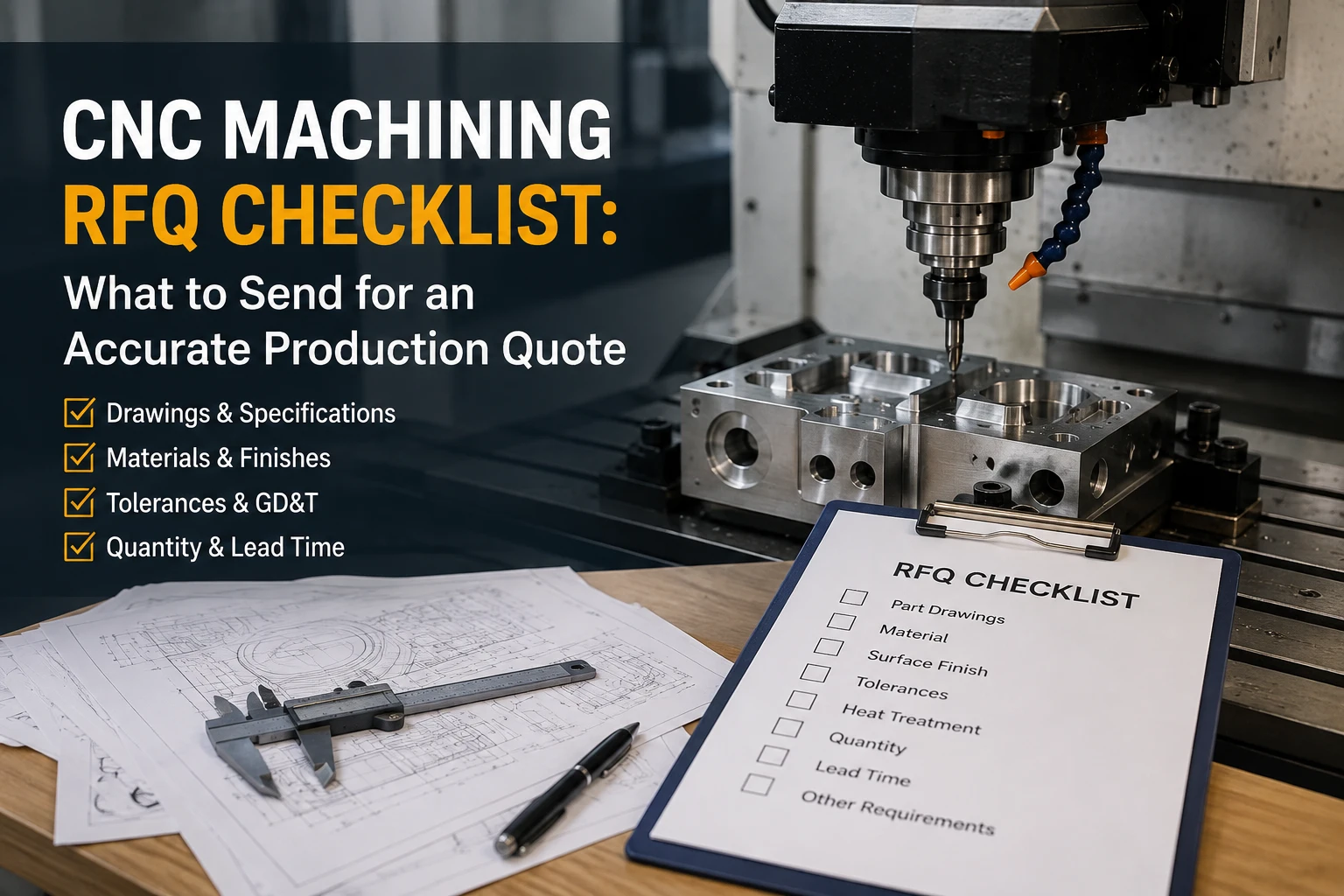
A CNC machining RFQ can produce very different prices when suppliers are working from different drawing revisions, material assumptions, tolerances, quantities, finishes, or inspection scopes. For a production quote, the goal is not simply to receive a price. It is to give each supplier enough controlled information to quote the same finished part under the same assumptions. A complete CNC machining RFQ checklist therefore needs to cover files, technical requirements, production demand, secondary operations, quality requirements, and quotation exclusions.
What Does a CNC Machining Supplier Need for an Accurate Quote?
Separate the Minimum RFQ Package From Project-Specific Requirements
A useful CNC machining quote package should first identify the part, current revision, geometry, material, quantity, critical tolerances, and required finished condition. If any of these are unknown, state that clearly instead of allowing each supplier to make a different assumption.
A practical minimum package usually includes:
- Current part number and revision
- 3D CAD model
- Controlled 2D drawing when required
- Material specification
- Quote quantity
- Critical dimensions and tolerances
- Threads and functional features
- Heat treatment or surface finish, if applicable
Production projects may also require annual demand, inspection documentation, packaging, mating-component information, marking, or special handling. The requirement depends on the application rather than a universal checklist.
What CAD Files and Drawings Should You Send for a CNC Machining Quote?
When Is a STEP File Enough—and When Do You Need a 2D Drawing?
A STEP model is useful for communicating part geometry. STEP is part of the ISO 10303 family for exchanging product data between computer systems. However, geometry alone may not communicate all manufacturing requirements.
A simple prototype with noncritical dimensions may sometimes be evaluated mainly from the 3D model. A production component with GD&T, special threads, surface roughness requirements, controlled datums, heat treatment, or inspection notes generally needs additional product-definition information.
ASME Y14.5 describes GD&T as a standardized language for communicating design requirements on engineering drawings, digital models, and related documents. The purchasing question is therefore not “Is STEP enough?” in isolation, but “Does the RFQ clearly communicate everything that controls form, fit, function, and inspection?”
Keep Part Numbers, File Names, and Revisions Consistent
Revision mismatch is one of the easiest ways to make CNC quotations incomparable. If one supplier quotes Rev B while another receives Rev C, differences in geometry, tolerance, or finishing can appear as price differences.
Use the same part number, model revision, drawing revision, quantity, and specification package for every bidder. When engineering changes occur, identify which files have been superseded and request confirmation that the revised quotation is based on the latest package.
For repeat production, this discipline becomes even more important because the quoted process, inspection plan, fixture assumptions, and secondary operations may all depend on the released revision.
How Should You Specify Material and Production Quantity?
Specify the Exact Material Requirement—and Whether Alternatives Are Allowed
“Aluminum” or “stainless steel” may be insufficient for an accurate production quote. When the application requires a particular grade, condition, temper, hardness, or material specification, put it on the drawing or RFQ.
If alternatives are acceptable, state that explicitly. A supplier should not have to decide independently whether a different alloy or stock condition is functionally equivalent.
Also identify any material-related secondary requirements, such as heat treatment or hardness, when they form part of the finished-part specification. These requirements can affect process planning and should not be added only after the machining price has been approved.
Separate Prototype Quantity From Repeat Production Demand
A prototype quote and a production CNC machining quote answer different purchasing questions.
For a prototype, the supplier may focus on rapid programming, readily available stock, flexible workholding, and a small quantity. Repeat production may justify different fixtures, tooling, batch planning, inspection methods, or machining routes.
Instead of sending only “Qty: 20,” consider providing:
- Current RFQ quantity
- Prototype or pilot quantity, if relevant
- Typical production release quantity
- Estimated annual demand, when reasonably known
These figures do not guarantee a particular price. They give the supplier enough context to propose a production route that fits expected demand rather than treating every order as a one-off job.
Which Tolerances and Functional Features Should Be Highlighted?
Highlight CTQ Features Instead of Tightening Every Dimension
Not every dimension controls part function. Bearing locations, alignment datums, sealing surfaces, mating interfaces, runout requirements, and precision bores may require closer control than clearance holes or nonfunctional external surfaces.
Blanket tight tolerances can add machining and inspection burden without improving the assembly. Instead, identify critical-to-quality or critical-to-function features and communicate the design intent clearly.
ASME notes that GD&T provides a common language for specifying and interpreting functional geometric requirements. Before the RFQ is issued, engineering and purchasing should agree on which characteristics genuinely require special control.
Specify Threads, Fits, Surface Finish, and Assembly-Critical Details
Thread size, pitch, depth, class or fit requirements, critical bore relationships, surface roughness, chamfers, burr-sensitive edges, and assembly interfaces can change the manufacturing route.
If a machined surface mates with a bearing, seal, another precision component, or a finished assembly, state that function when it helps the supplier understand the requirement. Do not rely on a CAD model to communicate a characteristic that exists only as manufacturing intent.
CK Metal Tech’s machining content similarly identifies material, key dimensions, tolerances, surface finish, heat treatment, threads, chamfers, inspection methods, and packaging as items to review before repeat CNC production.
What Secondary Operations Must Be Included Before Quotation?
Define the Complete Finished-Part Scope, Not Just the Machining Scope
A machining-only price is not an accurate finished-part quote if the component later requires grinding, heat treatment, anodizing, plating, coating, marking, cleaning, or assembly.
State required secondary processes before comparing bids. Also identify masked areas, surfaces affected by post-treatment buildup, or dimensions that must be controlled after heat treatment or finishing.
This is where OEM precision metal manufacturing becomes relevant: buyers should understand whether a quote covers only CNC cutting or the complete process route through finishing and other required operations. CK Metal Tech publicly lists CNC milling and turning alongside Swiss machining, surface treatment, sheet-metal fabrication, stamping, and assembly within its OEM/ODM manufacturing scope.
What Inspection and Documentation Requirements Should Be Defined?
Ask for the Quality Evidence the Project Actually Requires
Inspection requirements should be known before pricing, particularly when the buyer requires records beyond normal production inspection.
A project may call for measurements of selected CTQ features, dimensional reports, CMM-based inspection, material documentation, or other customer-defined evidence. The appropriate scope depends on the drawing, industry, risk, and purchasing specification.
Do not assume every document is automatically included. Requiring additional reporting after quotation can change inspection time and administrative scope. CK Metal Tech publicly lists machining and inspection-related resources as part of its broader integrated precision metal manufacturing capabilities, but the exact documentation for a specific RFQ should still be defined by the project.
What Makes a Production CNC RFQ Different From a Prototype RFQ?
Add Repeat-Production Controls, Release Pattern, and Packaging Requirements
A successful prototype proves that a part can be made; it does not automatically define how it should be purchased repeatedly.
For production, confirm the released revision, normal batch quantity, anticipated demand, critical inspection characteristics, secondary operations, and packaging requirements. Precision shafts, finished surfaces, threads, or cosmetic components may require packaging that protects the characteristics already paid for during manufacturing.
Production RFQs should also distinguish one-time costs from recurring part costs where applicable. This makes later purchase orders easier to evaluate and reduces the risk that a low prototype price is mistaken for a stable production price.
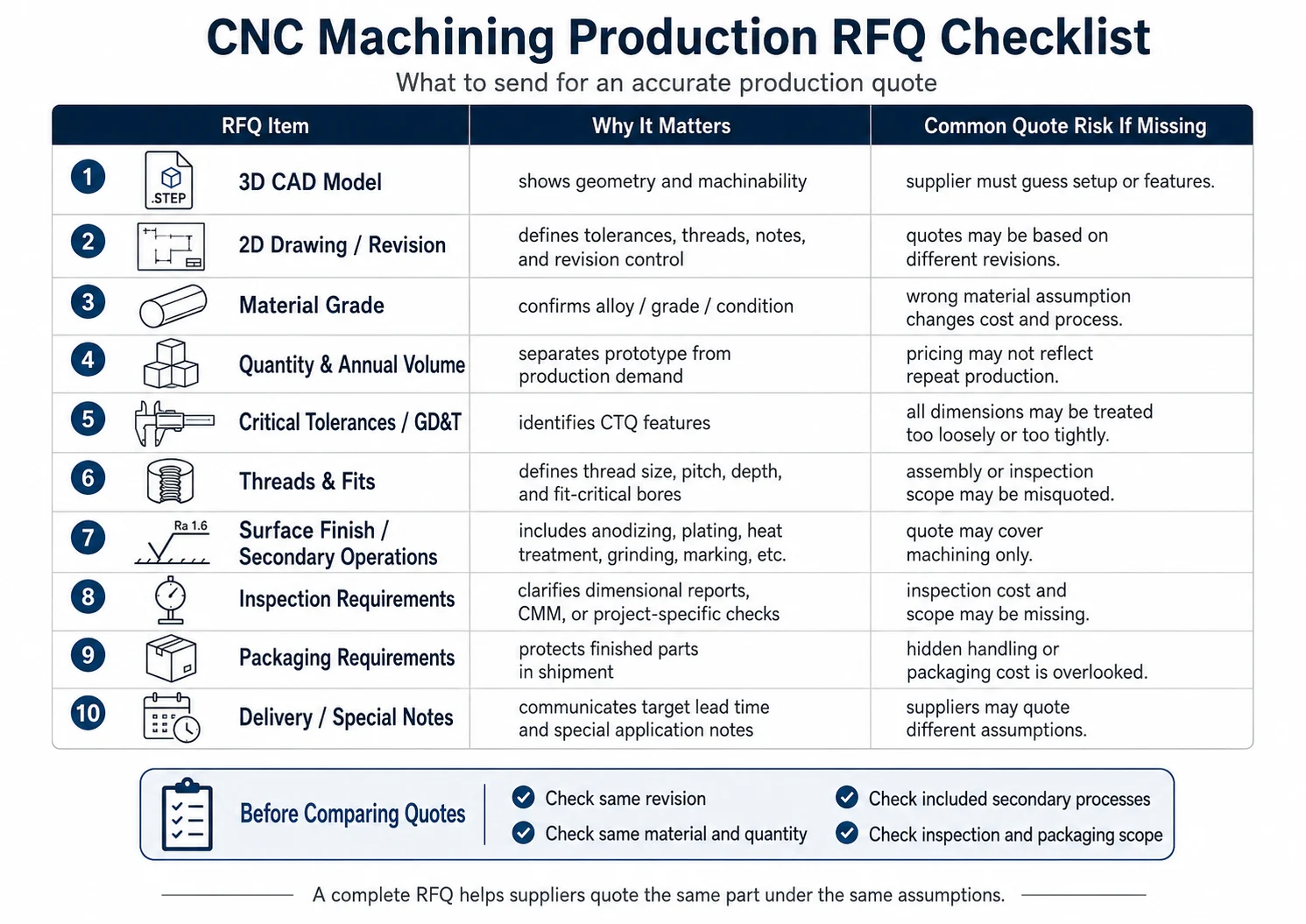
How to Compare CNC Machining Quotes From Multiple Suppliers
Compare Scope and Assumptions Before Unit Price
The lowest unit price is meaningful only when suppliers have quoted the same scope.
| Quote Check | Supplier A | Supplier B | Supplier C |
|---|---|---|---|
| Same drawing revision | |||
| Same material specification | |||
| Same production quantity | |||
| Critical tolerances included | |||
| Secondary processes included | |||
| Inspection/documentation included | |||
| Packaging included | |||
| Setup/NRE clearly identified | |||
| Delivery assumptions defined | |||
| Exclusions documented |
If one quotation includes grinding, finishing, inspection, and packaging while another covers machining only, the two unit prices are not equivalent.
This is also where one-stop precision metal manufacturing can affect sourcing decisions. When machining, finishing, fabrication, or assembly are split among suppliers, purchasing teams should compare the completed manufacturing route and supplier handoffs rather than one operation in isolation. CK Metal Tech’s existing sourcing guidance discusses the additional coordination, inspection, and responsibility created when processes are fragmented across suppliers.
How to Choose a CNC Machining Supplier for Repeat Production
Evaluate DFM, Process Planning, Inspection, and Secondary Capability
A production supplier should be able to explain how the drawing will be manufactured, not simply confirm that it can be made.
Ask which features drive the process, how the workpiece will be held, which dimensions require special inspection, what secondary operations are included, and whether prototype and production use the same route. The answers matter when comparing precision CNC machining services for repeat orders.
CK Metal Tech lists CNC lathes, vertical machining centers, Swiss machining, cylindrical and centerless grinding, thread-processing equipment, and related machining resources. The company also connects machining with other manufacturing and finishing processes where a finished component requires more than one operation.
The RFQ should still determine suitability. Machine availability alone does not prove that a supplier is the correct choice for a particular geometry, tolerance, material, quantity, or quality requirement.
Final CNC Machining Production RFQ Checklist
Before sending a request for quotation, confirm:
- Part number and current revision
- STEP or other agreed 3D model
- Controlled 2D drawing where required
- Material grade and condition
- Current RFQ quantity
- Prototype, pilot, or production status
- Expected repeat quantity or annual demand if relevant
- Critical dimensional tolerances
- GD&T where required
- Threads and fits
- Surface roughness and functional surfaces
- Heat treatment
- Plating, anodizing, coating, or other finish
- Masking or no-finish zones
- Inspection scope
- Required quality documentation
- Packaging requirements
- Target delivery requirement
- Approved alternatives or unresolved engineering questions
Conclusion
An accurate CNC machining production quote starts with controlled files, an exact material requirement, realistic quantities, clearly identified CTQ features, complete secondary operations, and a defined quality scope. Give every supplier the same information before comparing prices.
For a production review, prepare the drawing, 3D model, revision, material, quantities, tolerances, finish, inspection requirements, and any mating or application details that affect the part. Buyers can contact CK Metal Tech with that package for manufacturability review and quotation.
FAQs About CNC Machining RFQs
Is a STEP file enough for a CNC machining quote?
It may be sufficient for evaluating simple geometry or an early estimate, but a production part may also require a controlled drawing to communicate tolerances, GD&T, threads, finishes, notes, and inspection requirements. STEP is an established ISO 10303 product-data exchange format, but the RFQ must still communicate the complete manufacturing intent.
What files should I send for a CNC machining production quote?
Send the current 3D model and controlled drawing when applicable, with matching part numbers and revisions. Include material, quantity, critical tolerances, threads, finishing, secondary operations, inspection requirements, and other project-specific information.
Should I include annual volume in a CNC machining RFQ?
For repeat production, yes when a realistic estimate is available. State the immediate quote quantity separately from expected release quantities or annual demand so the supplier can evaluate both the current order and recurring production requirements.
Why are quotes for the same CNC part so different?
Different material assumptions, drawing revisions, tolerances, quantities, secondary processes, inspection scopes, packaging, or exclusions can produce different prices. Compare scope first, then compare unit cost.
Leave a reply