



CHUANGKAI

a i l a n d

Loading

     
home // blog

Industry blog

Powder Coating vs Wet Painting for Sheet Metal Parts: How OEM Buyers Choose

Powder Coating vs Wet Painting for Sheet Metal Parts How OEM Buyers Choose


For OEM buyers comparing powder coating vs wet painting for sheet metal parts, the real question is not which finish is “better” in general. The better choice depends on the part material, size, tolerance, appearance requirement, operating environment, annual volume, repair needs, and how the finished part will be assembled. Powder coating is often preferred for durable, repeatable production parts, while wet painting can be the better option for special colors, thin-film finishes, large parts, or easier touch-up.

Quick Answer: Powder Coating or Wet Painting?

Powder coating is generally used for metal sheets that need a durable coat and uniformity in repeat orders. According to the Powder Coating Institute, powder coating is the electrostatic process of applying powder, where charged particles get deposited on a grounded part and then formed into a coating. Additionally, it has been stated that products that have been coated with powder coating can resist impacts, moisture, chemicals, ultraviolet rays, and heat-related damage in appropriate applications.

Wet painting is more suitable when the project requires special color matching, very thin coating, multi-color surfaces, lower heat exposure, or field repair after installation. It may also be considered for large boxes, oversized welded frames, or parts that cannot easily pass through a powder coating line.

Buying Question Powder Coating May Fit Better Wet Painting May Fit Better
Is the part used in repeat production? Yes, especially for batches Sometimes, depending on color and setup
Is durability important? Often yes Depends on paint system
Is special color matching required? Possible, but must confirm powder availability Often easier
Are holes, threads, and grounding points critical? Requires masking and thickness review Still requires masking, but film may be thinner
Is field touch-up important? More difficult to match Usually easier to repair

Cost, Durability, and Lead Time: The Main Buying Trade-Offs

When Powder Coating Is Better for Repeat Production

Powder coating is commonly selected for custom powder coated sheet metal parts when buyers need repeatability, handling resistance, and a stable surface finish across production batches. It is often a strong fit for industrial enclosures, equipment covers, control cabinet panels, mounting brackets, and structural sheet metal parts that will be packed, shipped, assembled, and used in demanding environments.

The purchasing risk is that powder coating should not be treated as a final decorative step. It affects part design, masking, curing, packaging, and assembly. Before confirming powder coating for sheet metal parts, buyers should check color code, gloss, texture, coating thickness, masked areas, cosmetic surfaces, corrosion expectations, and annual volume. Powder coatings are also formulated without solvents, which can reduce VOC-related concerns compared with many solvent-based surface coating operations.

When Wet Painting Is Better for Special Finishes or Constraints

Wet painting may be the better choice when the part needs a special color, a very thin finish, a smooth high-cosmetic appearance, or easier local repair. It may also be useful when the assembly includes heat-sensitive components or when part size makes powder coating difficult.

However, wet painting still needs clear specifications. Buyers should not only write “black paint” or “blue finish” on a drawing. A practical RFQ should define RAL or Pantone reference, gloss level, texture, primer requirement if needed, drying expectations, masking areas, and whether the painted surface will be visible after installation.

Fit, Tolerance, and Assembly Risks Buyers Should Check

Coating Thickness, Holes, Threads, and Mating Surfaces

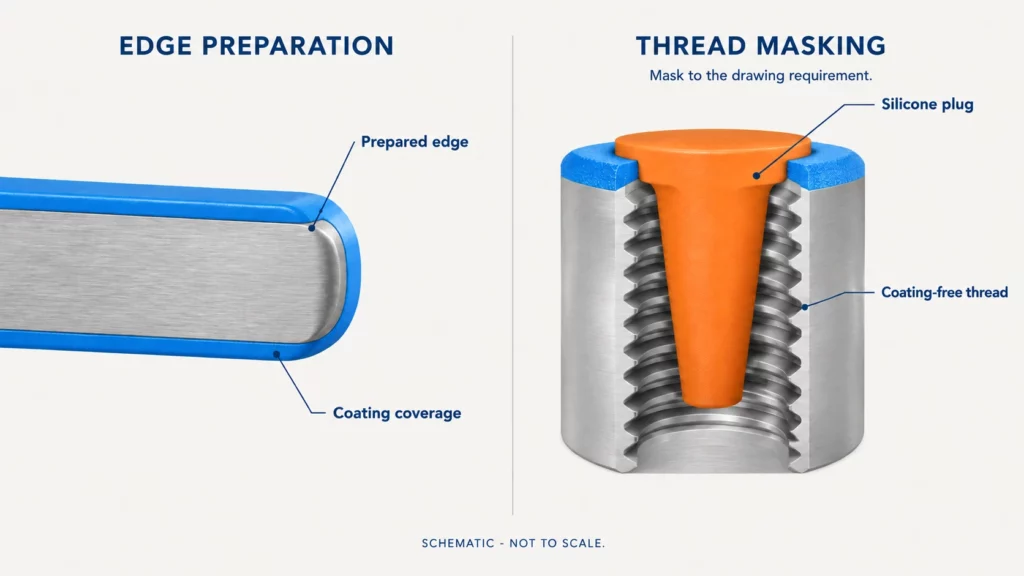
The most common engineering issue in powder coating vs painting metal parts is not appearance. It is fit. A coating layer can affect threaded holes, slots, PEM fasteners, grounding points, hinges, sliding surfaces, and tight assembly areas. A part may pass inspection before coating but fail during assembly because coating buildup was not considered at the design stage.

For tolerance-sensitive sheet metal parts, buyers should mark masked areas clearly on the drawing. Holes, threaded zones, electrical contact surfaces, bearing surfaces, and mating faces should be reviewed before production. The next step is to ask the supplier how coating thickness will be controlled, which areas will be plugged or masked, and whether first-article inspection will include coated-part assembly checks.

Color, Gloss, Texture, and Cosmetic Surface Requirements

Color mismatch is another frequent sourcing problem. Powder coating and wet painting can both create attractive finishes, but the result depends on color standard, resin system, gloss, texture, surface preparation, and batch control. A vague finish note can lead to disputes after sampling.

OEM buyers should define which surfaces are cosmetic and which are functional. A hidden mounting plate does not need the same visual acceptance criteria as a front medical equipment cover or control panel. For visible surfaces, sample approval, acceptable color variation, gloss range, and packaging protection should be agreed before mass production.

Material, Part Size, and Heat Exposure: What Can Limit Each Process?

Material Compatibility for Steel, Aluminum, Stainless Steel, and Galvanized Sheet

Among the various materials available for OEM sheet metal fabrication are cold-rolled steel, carbon steel, aluminum, stainless steel, galvanized sheet, and aluminum-zinc coated sheet, each of which will behave differently depending on forming, welding, cleaning, and finishing operations. The coating process must be appropriate to both the material being coated and the intended operating environment.


Steel components might be specified because of their strength or cost considerations. Aluminum will be used when weight is an issue. Stainless steel could be chosen when cleanliness or corrosion sensitivity is a consideration. Galvanized sheet or aluminum-zinc coated sheet might be specified where base-material corrosion resistance is needed. In any case, surface preparation must be checked prior to coating, particularly if there are welding residues, oil, oxidation, burrs, or grind marks.

Custom powder coated curved sheet metal enclosure for medical equipment


Large Enclosures, Welded Assemblies, and Heat-Sensitive Components

Large sheet metal enclosures, welded frames, and assembled housings require extra review before choosing powder coating or wet painting. Size, weight, hanging points, internal corners, weld seams, and edge protection all affect finish consistency.

A medical equipment curved sheet metal enclosure, for example, may involve SPCC cold-rolled steel, CNC laser cutting, curved forming, welding, grinding, polishing, and electrostatic powder coating. This type of part shows why finishing should be planned together with fabrication rather than added after the structure is complete. Buyers should confirm part size, surface visibility, ventilation slots, interface panels, coating requirements, and packaging before production.

Common Finish Problems and How OEM Buyers Can Prevent Rework

Poor adhesion, peeling, chipping, orange peel, color mismatch, blocked holes, and surface scratches usually come from preventable decisions. Common causes include insufficient cleaning, welding residue, rust, oil contamination, unsuitable masking, unclear cosmetic requirements, or packaging that does not protect finished edges.

The practical solution is early review. Buyers should share drawings, material, finish expectations, assembly requirements, and application environment before sampling. If the part will be installed outdoors, exposed to cleaning agents, handled frequently, or shipped overseas, the finishing requirement should reflect that use case. Coating quality is connected to fabrication quality, not separated from it.

RFQ Checklist: What to Specify Before Asking for a Quote

A useful sheet metal painting RFQ should give the supplier enough information to recommend powder coating, wet painting, or another surface finishing route.

Include these items before requesting a price:

  • Material and material thickness
  • Drawing revision and critical dimensions
  • Powder coating or wet painting preference, if already known
  • RAL, Pantone, sample color, gloss, and texture
  • Coating thickness requirement, if specified
  • Masked holes, threads, grounding points, and mating surfaces
  • Cosmetic surfaces and acceptable appearance limits
  • Indoor, outdoor, medical, electrical, industrial, or machinery application
  • Quantity, annual demand, and expected repeat order pattern
  • Packaging method and scratch-prevention needs

This information helps reduce quotation gaps, sample delays, and disputes after the first production batch.

How to Choose a Sheet Metal Fabrication and Finishing Supplier

Why Integrated Fabrication + Finishing Reduces Risk

A qualified sheet metal fabrication and finishing supplier should understand cutting, punching, bending, welding, grinding, riveting, powder coating, wet painting, inspection, and packaging as one connected workflow. This matters because a coating issue often starts before finishing: burrs, weld marks, tight holes, poor grounding surfaces, and weak packaging can all become coating-related purchasing problems.

Zhejiang Chuangkai Mechanical and Electrical Technology Co., Ltd. supports precision sheet metal processing, metal stamping, machining, surface painting, powder coating, and assembly. Buyers reviewing precision metal manufacturing and assembly solutions can evaluate whether a single supplier can support both fabricated parts and finished metal components for OEM equipment projects.

Supplier selection should also include communication. Before sending drawings, buyers can review about Zhejiang Chuangkai Mechanical and Electrical Technology Co., Ltd. to understand the company background, then prepare drawings, material notes, finish requirements, target quantity, application details, and sample expectations.

Conclusion

Powder coating vs wet painting for sheet metal parts should be decided by application, not habit. Powder coating is often suitable for repeat production, durable handling surfaces, and consistent appearance. Wet painting may be better for special color matching, thin film, oversized parts, heat-sensitive assemblies, or easier field repair.

For OEM projects involving enclosures, covers, chassis, brackets, panels, or welded frames, buyers should confirm material, part size, coating thickness, masking, cosmetic surfaces, corrosion expectations, assembly risks, and packaging before production. Zhejiang Chuangkai Mechanical and Electrical Technology Co., Ltd. can review custom sheet metal parts, coating needs, samples, target quantities, application scenarios, drawings, and surface finish requirements. Buyers may contact Chuangkai for a custom metal parts quote when the project is ready for manufacturing review.

FAQs

Q1: Which is better, powder coating or wet painting, for sheet metal parts?

A: Powder coating may be better than wet painting if the sheet metal parts will have to undergo repeat production and will require durability and handling resistance as well as good visual uniformity. Wet painting can be better if there is a requirement for unusual colors, thin film, large parts, multiple colors, or touch up.


Q2: Why would an OEM buyer select wet painting over powder coating?

A: Wet painting is an option if the part will require close color match, thin film, reduced heat exposure, touch up after installation, or if the color or texture desired is not among the powder coating options.


Q3: Can powder coating cause assembly problems on sheet metal parts?

A: Yes. Powder coating may affect holes, slots, threads, grounding points, PEM fasteners, hinges, and mating surfaces if coating thickness and masking are not considered. Buyers should mark masked areas on drawings and check coated samples before mass production.


Q4: What should be covered in an RFQ on sheet metal painting and powder coating?

A: A full RFQ should cover material, material thickness, drawing revision number, color code, gloss level, texture, thickness of the coating, masked areas, cosmetics surface, application environment, volume, corrosion expectations, and packaging specifications.


Q5: How to select a supplier for my custom powder coated sheet metal components?

A: Select a supplier who is able to review drawings, knows how to manufacture sheet metal products, controls quality of welding/grinding process, powder coating/wet painting process, inspecting finished components and packaging coated components based on the final application.

24th July 2026

Large Sheet Metal Enclosure Powder Coating: Oven Size, Handling and Batch Production

Large Sheet Metal Enclosure Powder Coating Oven Size, Handling and Batch Production


Large sheet metal enclosure powder coating is not only a finishing question. For OEM buyers, the real concern is whether a supplier can safely handle the part size, cure the coating consistently, protect cosmetic surfaces, and repeat the process during batch production. A large enclosure, cabinet, chassis, or equipment housing may look simple on a drawing, but coating problems often appear after welding, grinding, masking, hanging, curing, or packaging.

Powder coating can be a good choice for large metal enclosures when durability, batch consistency, and a clean industrial appearance matter. However, the decision should be verified against the actual enclosure size, material, weight, geometry, coating specification, and assembly requirements.

Can Large Sheet Metal Enclosures Be Powder Coated?

Large sheet metal enclosures can be powder coated when the part can be cleaned, grounded, sprayed, moved, cured, inspected, and packaged without damaging the surface or affecting assembly. This applies to many equipment enclosures, electrical cabinets, communication boxes, industrial control housings, chassis assemblies, and medical or inspection equipment structures.

The first mistake is assuming that “large” only means length, width, and height. For powder coating large metal enclosures, buyers also need to consider diagonal size, door opening clearance, lifting method, hanging direction, deep internal corners, vents, weld seams, masked holes, and cosmetic A-surfaces. If a housing is close to the supplier’s oven limit, the coating plan may need adjustment before quoting.

Powder coating works well when the enclosure is designed for repeat production and the finish needs to withstand handling, assembly, export packaging, and service conditions. It becomes risky when the enclosure is too large to hang safely, too thin to resist heat-related distortion, already assembled with heat-sensitive components, or full of narrow recesses that are difficult to coat evenly.

Oven Size Is Only the First Capacity Check

When buyers search for powder coating oven size for large parts, they usually want a simple answer: “Will this enclosure fit?” That answer depends on usable oven space, not just the nominal oven size. A supplier must account for racks, hooks, hanging height, part rotation, airflow clearance, door clearance, and safe loading space.

Usable Oven Space, Clearance, and Hanging Orientation

A large enclosure that fits on paper may still be difficult to coat in production. If it must be hung at an angle, the effective size becomes larger. If lifting tabs, flanges, handles, or welded brackets protrude from the main body, they may reduce usable clearance. If the part has a large open side, the hanging direction may affect how powder enters internal surfaces.

Buyers should send drawings or 3D files that clearly show overall size, maximum diagonal, weight, lifting points, and the required cosmetic surfaces. The RFQ should also state whether the enclosure will be coated before or after assembly. This matters because assembled parts may include inserts, seals, labels, rubber parts, or electrical items that may not tolerate powder coating cure conditions.

Curing consistency is another capacity issue. Industrial batch powder ovens are designed around temperature distribution, heat-up, and recovery, and GFS describes batch powder ovens as equipment used for batch powder coating applications where heat distribution and throughput affect coating results. For large boxes and cabinets, buyers should confirm that the supplier can cure the full part consistently, not only coat the visible outer surface.

Handling, Racking, and Masking Risks Before Powder Coating

Large enclosures are more likely to be damaged during movement than small brackets or panels. Before coating, unfinished sheet metal can be scratched, bent, contaminated, or touched on cosmetic surfaces. After coating, the risk changes: edges, corners, wide flat panels, and visible doors can be damaged during unloading, inspection, packaging, or assembly.

Handling, Racking, Holes, Threads, and Grounding Areas

Handling large parts during powder coating requires more than strong racks. The supplier should decide where the enclosure can be lifted, where hooks can contact the part, which surfaces must remain mark-free, and how the part will move between fabrication, cleaning, spraying, curing, and packing. Poor racking can leave contact marks, bare spots, thin edge coverage, or visible hanging points.

Powder coated security inspection equipment chassis assembly


Masking should be reviewed before production. Large sheet metal enclosures often include threaded holes, PEM fasteners, grounding areas, sliding surfaces, hinge points, mounting holes, vent openings, and assembly faces. If these areas are not masked correctly, coating buildup may cause assembly problems. If too much masking is used, the finished part may lose protection in areas that still require coverage.

A practical drawing should mark masked holes, uncoated grounding zones, critical mating faces, cosmetic surfaces, and coating thickness expectations. This is especially important for a security inspection equipment chassis assembly, where structural strength, internal assembly, access openings, coated surfaces, and final fit may all affect the finished equipment.

Batch Production: How Large Enclosures Affect Cost and Lead Time

Batch powder coating for large enclosures is often different from coating small parts on a dense rack. A large cabinet may occupy the space of many smaller parts, which can reduce rack density and change the cost per piece. Color changes, masking time, loading method, curing time, and inspection requirements may also affect scheduling.

For large enclosure powder coating, the buyer should not only ask for a unit price. It is better to ask how many parts can be coated in one batch, whether the same rack setup can be repeated, how color and texture changes are managed, and whether the coating route is suitable for the expected annual volume.

Batch production can be suitable for large sheet metal cabinets, welded frames, large covers, and custom equipment boxes because it allows more flexible racking and handling. However, it may not be the most efficient option if the part design changes frequently, if the color changes for every small order, or if masking is too complex for stable repeat production. Clear volume forecasts help the supplier plan whether sample approval, first article inspection, and batch loading can be controlled consistently.

Design and Surface Preparation Risks That Affect Finish Quality

Large powder coated sheet metal enclosures expose design and surface preparation issues more clearly than small hidden components. Wide panels show grinding marks. Corners reveal thin coverage. Welded seams may telegraph through the finish. Vents and deep recesses may receive less powder than flat outside surfaces.

Deep Corners, Welded Seams, and Large Cosmetic Surfaces

Complex geometry can create coating challenges in recessed areas and tight corners. In powder coating, the Faraday cage effect can make it harder for charged powder to reach inside corners and narrow recesses; industry discussions commonly link this issue to thin or uneven coverage in corners and complex geometries. For large metal boxes, this risk may appear around vent slots, folded channels, internal corners, louvers, and welded pockets.

Surface preparation also matters. Oil, rust, oxide, burrs, welding residue, uneven grinding, and sharp edges can affect coating appearance or adhesion. Before approving batch production, buyers should check sample parts for edge coverage, hole buildup, weld areas, panel flatness, cosmetic surface quality, and packaging protection. If an enclosure has a large front door or outer cover, the cosmetic acceptance standard should be agreed before production, not after shipment.

RFQ Checklist for Large Powder Coated Sheet Metal Enclosures

A useful RFQ for large powder coated enclosures should give the supplier enough information to review manufacturing feasibility, not just quote a finish color.

RFQ Item Why It Matters
Overall size and maximum diagonal Confirms usable oven space, door clearance, and hanging direction
Weight and lifting points Helps plan racking, loading, and safe handling
Material and thickness Affects forming, welding, heat exposure, and surface preparation
Drawing revision and 3D model Reduces misunderstanding around holes, bends, and assembly faces
Color, gloss, and texture Prevents finish mismatch between batches
Coating thickness requirement Affects durability, holes, tolerances, and fit
Masked holes, threads, and grounding areas Prevents blocked holes, poor grounding, and assembly interference
Cosmetic surfaces Defines visible areas and inspection expectations
Batch quantity and annual volume Supports cost, scheduling, and repeat production planning
Packaging requirement Protects coated edges, panels, and corners during transport

How to Choose a Supplier for Large Sheet Metal Enclosure Powder Coating

For OEM buyers, a qualified supplier should understand the entire route: cutting, punching, bending, welding, grinding, powder coating, inspection, packaging, and assembly. Large enclosure finishing should not be treated as a final decoration step. It should be planned together with fabrication.

Why Fabrication, Welding, and Powder Coating Should Be Planned Together

When fabrication and coating are managed separately, problems may appear late: warped panels, unmasked threads, coating buildup on mating surfaces, visible grinding marks, or packaging damage after finishing. A supplier that reviews fabrication and finishing together can identify these risks earlier.

Zhejiang Chuangkai Mechanical and Electrical Technology Co., Ltd. supports OEM metal parts through precision metal manufacturing and assembly solutions, including precision sheet metal processing, surface painting, powder coating, and assembly. Its powder coating and painting setup includes an automatic powder coating line, a manual powder coating line for large parts and large boxes, a manual painting line for large parts and large boxes, and an automatic powder coating and painting hybrid line under construction. Buyers can also review about Zhejiang Chuangkai Mechanical and Electrical Technology Co., Ltd. when evaluating company background and manufacturing scope.

Supplier questions before sending drawings should include:

  • What is the usable oven space for this enclosure size?
  • How will the part be lifted, racked, grounded, and protected?
  • Which holes, threads, grounding areas, and cosmetic surfaces should be masked?
  • How many large enclosures can be coated in one batch?
  • How will coating thickness, appearance, and packaging be checked?

Conclusion

Large sheet metal enclosure powder coating should be evaluated through oven size, usable clearance, handling, racking, masking, curing consistency, batch loading, inspection, and packaging. The better supplier is not simply the one that can spray powder onto a large box, but the one that can review the full manufacturing route and reduce risks before batch production.

For projects involving large enclosures, equipment cabinets, chassis assemblies, or powder coated sheet metal structures, buyers can prepare drawings, material requirements, size, weight, coating color, masking notes, target quantity, application environment, and packaging expectations before requesting a quote. To discuss production feasibility or RFQ details, buyers may contact CK Metal Tech with drawings, samples, or project requirements.

FAQs

Q1: How big can a sheet metal enclosure be for powder coating?

A: It depends on the supplier’s usable oven space, door clearance, hanging method, part weight, and airflow clearance. Buyers should provide overall dimensions, maximum diagonal, weight, and 3D drawings for review.


Q2: Does powder coating large enclosures affect lead time?

A: Yes, it may affect lead time because large parts reduce rack density, require more careful handling, and may need longer scheduling around curing, masking, inspection, and packaging.


Q3: What causes uneven powder coating on large metal boxes?

A: Common causes include deep corners, recessed areas, vent slots, poor grounding, difficult spray angles, surface contamination, welded seams, and inconsistent curing.


Q4: What should be included in an RFQ for large powder coated enclosures?

A: Include size, weight, material, drawing revision, coating color, gloss, texture, thickness, masked areas, cosmetic surfaces, batch quantity, annual volume, application environment, and packaging requirements.


23rd July 2026

Shot Blasting Before Powder Coating: When OEM Metal Parts Need It

Shot Blasting Before Powder Coating When OEM Metal Parts Need It

Preparation through shot blasting prior to powder coating is not always essential in all metal parts. The right response for OEM metal parts is contingent upon the metal part, its surface, weld residues, rust, mill scale, metal part thickness, appearance requirements, and final environment where the metal part would be utilized. In case the pretreatment procedure fails, then the powder coating process may peel, blister, and corrode. On the other hand, if the pretreatment procedure is too aggressive, it may damage sheet metal, aluminum parts, threads, mated surfaces, or panel areas before applying the coating process.

Is Shot Blasting Always Necessary Before Powder Coating?

Shot blasting is preferred where rusted, oxidized, old-coated, welding spattered and otherwise heavily contaminated fabricated steel components are involved. It could be useful to achieve a profile which will facilitate powder coating adhesion. Such a case would pertain to welded metal fabrications, machinery frames, industrial chassis and carbon steel structures which would later be lifted, transported, assembled or subjected to humid conditions.

But a freshly cleaned sheet metal might not require shot blasting at all. Where thin sections, aluminum sheet metal, galvanized steel, stainless steel or high appearance panels are concerned, cleaning, degreasing, mild abrasion or chemical pretreatment may be preferable options. The buyer must enquire about the problem that the supplier is trying to solve through pretreatment: rust removal, oxide removal, surface profiling, removal of old coating or adhesion enhancement.The answer should drive the pretreatment route.

Shot Blasting vs Sandblasting vs Chemical Pretreatment

Different suppliers may use terms such as shot blasting, sandblasting, media blasting, abrasive blasting, or powder coating pretreatment. These methods should be compared by material, part geometry, contamination level, surface profile, and coating performance target—not by name alone.

Method More Suitable For Main Risk to Check
Shot blasting Steel parts, welded fabrications, rust, mill scale, larger structural parts Over-blasting thin panels, threads, or cosmetic faces
Sand/media blasting Local cleaning, old coating removal, complex shapes Wrong media may roughen or damage soft materials
Chemical pretreatment Cleaner sheet metal, thin parts, aluminum or galvanized surfaces May not remove heavy rust or mill scale alone
Combined process Higher corrosion requirements or mixed surface conditions Added cost if each step has no clear purpose

For buyers who need broader background on cleaning, masking, spraying, curing, and material compatibility, see powder coating process for sheet metal parts and enclosures.

Material and Part Geometry Risks Before Blasting

Carbon steel and welded fabrications are the most common candidates for mechanical pretreatment. Weld zones, heat-affected areas, sharp burrs, corners, deep pockets, and grinding marks should be reviewed before blasting. A part that looks clean from a distance may still have welding residue or uneven surface texture that appears clearly after powder coating.

Powder coated medical and industrial equipment chassis assembly made from SPCC sheet metal

Thin sheet metal requires more caution. Large flat panels may warp if impact intensity, exposure time, or media choice is not suitable. Aluminum may need a gentler approach because excessive blasting can roughen the surface or affect appearance. Stainless steel should be protected from cross-contamination, and galvanized steel should not be heavily blasted without checking whether the zinc layer may be damaged.

Threads, PEM fasteners, grounding points, sliding rails, bearing faces, sealing surfaces, and mating edges should be marked on the drawing. These areas may need masking or protection before blasting and powder coating.

A practical product example is powder coated medical and industrial equipment chassis assembly, which uses SPCC cold-rolled steel with electrostatic powder coating and follows a CNC punching, bending, welding, powder coating, and assembly route for medical equipment, industrial testing, and communication equipment applications.

Why Powder Coating Can Still Fail After Shot Blasting

Shot blasting does not solve every coating problem. Powder coating can still peel after blasting if oil, dust, abrasive residue, fingerprints, flash rust, moisture, or incompatible pretreatment remains on the surface. Blistering may point to trapped contamination or moisture. Rust under the coating may suggest poor surface protection after blasting, exposed edges, or a coating system that does not match the operating environment.

A rough finish can also come from incorrect media selection or excessive surface profile. If the profile is too deep for the coating system, the finished part may show visible texture variation or weak coverage at peaks and edges. For cosmetic surfaces, buyers should define acceptable appearance, visible faces, sample approval requirements, and inspection points before production.

What Buyers Should Specify in an OEM Powder Coating RFQ

A clear RFQ should describe the incoming part condition and expected finished performance. Avoid writing only “shot blast and powder coat.” Include:

  • Base material, grade, thickness, and part size
  • Rust, mill scale, welding residue, oil, or old coating condition
  • Cosmetic and non-cosmetic surfaces
  • Areas that must not be blasted or coated
  • Threads, grounding points, mating surfaces, and fitted areas
  • Required powder coating system, color, gloss, and texture
  • Indoor, outdoor, humid, or corrosive operating environment
  • Sample approval, inspection, packaging, and batch quantity

This helps different shot blasting and powder coating suppliers quote against the same requirements.

How to Choose a Shot Blasting and Powder Coating Supplier

A qualified OEM metal finishing supplier should review fabrication, welding, surface preparation, powder coating, inspection, and assembly as one connected workflow. Cutting burrs, weld spatter, grinding marks, blasting media, coating thickness, and packaging can all affect the final part.

Zhejiang Chuangkai Mechanical and Electrical Technology Co., Ltd. supports precision sheet metal processing, metal stamping, precision machining, surface painting, powder coating, and assembly; its About page describes the company as a one-stop solution provider for multiple metal component processes. Buyers can review about Zhejiang Chuangkai Mechanical and Electrical Technology Co., Ltd. when checking supplier background.

CK Metal Tech’s homepage lists sheet metal processing equipment for cutting, punching, bending, riveting, welding, grinding, and related operations, along with automatic and manual powder coating and painting lines. For projects requiring coordinated fabrication and coating review, CK Metal Tech precision metal manufacturing services can be used as the main company entry point.

Conclusion: Specify the Surface Condition, Not Just the Finish

Shot blasting before powder coating should be specified only when it fits the material, part condition, geometry, appearance target, and operating environment. Buyers should define the problem to be solved, protected areas, coating requirements, inspection method, and packaging expectations before quotation.

For a project review, buyers can contact Chuangkai for a custom metal parts quote with drawings, material, thickness, part photos, current surface condition, target quantity, application environment, and any coating failure or assembly issue photos.

FAQs

Q1: Is shot blasting required before powder coating new steel?

A: Not always. Clean new steel may only need cleaning, degreasing, sanding, or chemical pretreatment. Shot blasting is more likely needed when there is rust, mill scale, welding residue, old coating, or heavy surface contamination.


Q2: Can thin sheet metal warp during shot blasting?

A: Yes, it may. The risk depends on sheet thickness, panel size, structural rigidity, blast media, impact intensity, and exposure time. Thin panels or visible covers should be tested with samples before batch production.


Q3: Why does powder coating peel even after the part was blasted?

A: Peeling may come from dust, oil, abrasive residue, flash rust, moisture, poor handling after blasting, incompatible pretreatment, or curing problems. Blasting is only one part of the powder coating pretreatment process.


Q4: How soon should steel be powder coated after blasting?

A: The waiting time should be kept as short as practical and controlled by humidity, handling method, storage condition, and contamination risk. Bare blasted steel should not be left exposed without process control.


Q5: Should galvanized steel be shot blasted before powder coating?

A: Heavy blasting should not be assumed. Galvanized steel may need a gentler surface preparation method depending on zinc layer condition, adhesion requirements, coating system, and final environment.

17th July 2026

Powder Coating for Sheet Metal Parts and Custom OEM Enclosures

Powder Coating for Sheet Metal Parts and Custom OEM Enclosures

Powder coating on sheet metal components may be required where the OEM purchaser requires more than just cleanliness in appearance. The enclosures, chassis, covers, brackets and panels will need to be handled as part of the assembly process, shipped, mounted in the equipment, and possibly cleaned, vibrated, heated, or maintained. If the powder coating flakes off the component, making holes or access areas inaccessible, this will become a procurement and engineering problem, not an aesthetic one.

Why Powder Coating Matters for OEM Sheet Metal Parts and Enclosures

Powder coating is usually a strong fit for repeat-production sheet metal components where appearance consistency, surface protection and handling resistance matter. It is commonly used on equipment housings, industrial covers, medical equipment enclosure parts, electrical panels, communication boxes and other powder coated sheet metal components. The finish should be reviewed together with material, bending, welding, masking, coating thickness, curing and packaging, because the coating result depends on the whole manufacturing route.

When Powder Coating Is the Right Finish

Powder coating would work well in a situation where custom-made sheet metal needs to have a protective surface coating after laser cutting, punching, bending, welding, and even riveting. This finishing process is very useful for OEM sheet metal enclosure, chassis, cover, frame and even visible equipment panel. If the project involves a lot of handling, finished part shipping or a situation where appearance is important, buyers should look at powder coating.

The project could be better suited for painting or other type of coating if it involves extremely thin coating film, special decorative effect or if the part cannot withstand oven coating. In those cases, painting or another finish should be reviewed before RFQ.

Materials and Part Geometry That Affect Powder Coating Quality

The same powder coating specification can perform differently on cold-rolled steel, aluminum, stainless steel, galvanized sheet or aluminum-zinc coated sheet. Surface condition, welding marks, burrs, oil, oxidation and grinding consistency all affect the finished appearance and adhesion. For buyers comparing powder coated steel sheet metal parts with aluminum or stainless steel parts, material choice should be based on equipment environment, weight target, corrosion risk, forming difficulty and cost.

Steel, Aluminum and Stainless Steel: How to Choose the Substrate

Cold-rolled steel is often selected for indoor equipment housings and powder coated steel sheet metal parts where forming, cost control and appearance are important. Aluminum may be preferred for lightweight covers, control panels or communication enclosures, but pretreatment should be checked carefully. Stainless steel may be selected for cleaner or more corrosion-sensitive environments, although powder coating may not always be necessary depending on the application.

Procurement teams should confirm material grade, thickness, surface condition, expected environment and cosmetic surfaces before asking for a quote.

Flat Covers, Welded Chassis and Enclosures: Why Geometry Changes Coating Risk

Large flat covers, deep enclosures, welded frames, ventilation slots and folded edges create different coating risks. Corners may receive thinner coverage, threaded holes may collect coating buildup, and welded surfaces may show grinding marks after coating. For powder coated sheet metal enclosures, the drawing should identify visible faces, hidden faces, hanging points, mating areas and assembly-sensitive openings.

For detailed process background, buyers can review powder coating process for sheet metal parts and enclosures before finalizing coating requirements.

Common Powder Coating Problems on Sheet Metal Parts and How to Prevent Them

Coating problems usually begin before spraying. Peeling, poor adhesion, color mismatch, blocked holes and assembly interference often come from incomplete pretreatment, unclear drawings, missing masking instructions or treating finishing as a separate step after fabrication.

Peeling, Poor Adhesion and Rust After Powder Coating

Peeling may occur when oil, rust, oxide, welding residue, sharp burrs or uneven surface preparation remain on the part. Rust may also appear if the base material, coating system or operating environment is not matched correctly. The practical response is to review pretreatment, sample approval, weld grinding, edge conditions and the application environment before mass production.

For critical parts, buyers should not approve only by color. Adhesion-sensitive areas, edges, welded zones and packaging contact surfaces should also be checked.

Coating Buildup on Threads, Grounding Points and Tight Areas

A part can pass dimensional inspection before coating but fail during assembly after coating. This often happens when threaded holes, grounding points, PEM fasteners, bearing surfaces or tight slots are not masked. The drawing should mark no-coat areas clearly, especially where electrical contact, screw fitting or panel alignment matters.

Powder Coating Specifications Buyers Should Confirm Before RFQ

A useful RFQ should not simply say “black powder coating.” It should define color reference, gloss, texture, coating thickness if required, cosmetic surface level, masking zones, quantity, packaging method and application environment. Buyers should also state whether the part is a cover, bracket, chassis, medical device enclosure, security inspection chassis or industrial equipment housing.

RFQ Checklist for Custom Powder Coated Sheet Metal Parts

Before sending drawings, include 2D/3D files, material and thickness, annual or batch quantity, color standard, gloss, texture, coating thickness requirement, masked areas, inserts or hardware, assembly requirements, inspection points, packaging needs and operating environment. If the part is replacing an existing supplier’s component, include photos of coating defects, assembly issues or failed samples.

Application Fit: Medical, Security and Industrial Equipment Enclosures

Different OEM equipment categories create different enclosure requirements. Medical equipment may need smooth surfaces, curved forming, ventilation and stable appearance. A related example is medical equipment curved sheet metal enclosure, which uses SPCC sheet metal, curved forming, welding, grinding and electrostatic powder coating for medical equipment housing applications.

Security inspection equipment often needs stronger structure, rails, access doors, cooling design and coating durability. The security inspection equipment chassis assembly example uses SPCC, SUS304 and aluminum alloy profiles with electrostatic powder coating, plus rails, latch assembly and structural features for security inspection equipment.

Powder coated security inspection equipment chassis assembly for custom OEM sheet metal enclosures

Application Main Purchasing Focus Common Risk to Check
Medical equipment enclosure Cleanable surfaces, appearance, ventilation, fitted internal structure Coating defects on visible curved surfaces
Security inspection chassis Strength, rails, maintenance access, cooling, durable coating Assembly interference after coating
Industrial equipment enclosure Cost, durability, heat dissipation, service access Poor masking around holes and grounding points

How to Choose a Sheet Metal Fabrication and Powder Coating Supplier

A qualified supplier should understand fabrication and finishing as one connected workflow. Cutting quality affects burrs. Bending affects panel fit. Welding affects distortion and grinding marks. Powder coating affects holes, slots, threads, grounding and visible surfaces. Packaging affects whether the coating survives shipment.

Zhejiang Chuangkai Mechanical and Electrical Technology Co., Ltd., operating under CK Metal Tech, supports precision sheet metal processing, metal stamping, machining, surface painting, powder coating and assembly. Its powder coating and painting capabilities include automatic powder coating, manual powder coating for large parts and large boxes, manual painting, and an automatic powder coating and painting hybrid line under construction. Buyers can review CK Metal Tech precision metal manufacturing services when evaluating whether one supplier can support fabrication, coating and assembly under a coordinated process.

Conclusion

Powder coating works well for OEM sheet metal parts and custom enclosures when it is specified early, not treated as a final decorative step. Buyers should review material, geometry, surface preparation, masking, coating requirements, application environment, inspection and packaging before production. For custom powder coated sheet metal enclosures, the safest RFQ includes drawings, dimensions, material, coating details, quantity, application scenario, samples if available, and photos of any existing coating or assembly issues.

For drawing review, sample discussion or project quotation, buyers can contact Chuangkai for a custom metal parts quote with product size, material, target quantity, coating requirement, operating environment and assembly notes.

FAQs

Q1: What should be included in powder coating specifications for sheet metal enclosures?

A: Include material, drawing revision, color reference, gloss, texture, coating thickness if required, masked areas, cosmetic surfaces, grounding points, threaded holes, application environment, quantity and packaging method.


Q2: How do I know if powder coating or painting is right for my OEM metal parts?

A: Powder coating is usually suitable for repeat-production parts requiring durable and consistent surfaces. Painting may be better for special color effects, thin-film requirements, very large parts or heat-sensitive components.


Q3: Why do threaded holes get blocked after powder coating?

A: Threaded holes may get blocked when coating thickness is not considered or masking is missing. Threads, PEM fasteners, grounding points and mating surfaces should be marked clearly on the drawing before coating.


Q4: Can powder coated sheet metal enclosures be used for medical or security equipment?

A: Yes, when the material, structure, coating, cleaning needs, access layout and operating environment are reviewed together. Medical enclosures and security inspection chassis have different priorities, so the RFQ should describe the specific equipment application.


Q5: How can buyers reduce coating problems before mass production?

A: Provide complete drawings, define masking areas, confirm coating appearance and thickness requirements, review sample parts, check assembly fit after coating, and select a supplier that understands both sheet metal fabrication and powder coating.


16th July 2026

Precision Sheet Metal Fabrication Supply Chain Risk Reduction for OEM Buyers

For OEM buyers, precision sheet metal fabrication supply chain risk reduction is not only about avoiding material shortages. Many project delays, quality issues and cost increases appear between processes: a drawing change is not shared clearly, a bent part does not fit after welding, powder coating changes a critical hole size, or several suppliers disagree about who is responsible for a defect.

When sheet metal parts are used in electrical equipment, industrial automation, agricultural machinery, power equipment or assembled metal enclosures, small process problems can affect final equipment delivery. The goal is not simply to find the lowest unit price. The goal is to choose a fabrication route and supplier structure that reduce lead time risk, quality risk and supplier management cost.

Why Supply Chain Risk Matters in Precision Sheet Metal Fabrication

Many sheet metal parts go through many processes before becoming completed components including laser cutting, punching, bending, riveting, welding, grinding, surface finishing, painting, powder coating, inspection, packing and assembly. Each process influences the subsequent operation.

For instance, the cut component may seem good but its bend allowance might not correspond to the material thickness and part configuration. The welded case might fulfill structural specifications but heating distortions may affect its assembly. The coated bracket may appear good but its coating thickness in areas of holes, mating surfaces and threaded fasteners may lead to fit up problems.

This is why OEM sheet metal fabrication risk is closely related to process planning. A buyer who evaluates only piece price may miss hidden costs from rework, repeated inspection, extra transportation, repacking, engineering communication and production schedule changes.

Common Risks OEM Buyers Face in Sheet Metal Fabrication

A practical risk review should focus on where the project can fail before mass production begins.

Engineering change and drawing revision risk

Many sheet metal projects change during development. Hole positions, mounting tabs, surface requirements or welded structures may be adjusted after sample testing. If cutting, bending, welding and coating are handled by separate suppliers, every revision must be communicated across the full chain. Any missed update can lead to wrong parts, delayed samples or mixed inventory.

Tolerance and assembly risk

Precision sheet metal fabrication often depends on cumulative tolerances. A single operation may be within tolerance, but the finished assembly may still fail if bending springback, welding distortion, coating thickness or fastener location is not considered together. Buyers should ask how the supplier checks finished parts, not only how each single operation is processed.

Lead time and production scheduling risk

Lead time risk usually grows when parts wait between suppliers. Cutting may finish on time, but welding capacity may be full. Painting may be delayed because large boxes and small brackets require different handling. A shortage of one small machined insert or stamped clip can stop final assembly. For repeat OEM production, production scheduling matters as much as fabrication capability.

Responsibility and communication risk

When several suppliers touch the same part, responsibility can become unclear. A welding supplier may blame cutting accuracy. A painter may blame surface preparation. An assembly team may blame coating thickness. Buyers need a clear process owner who can review the complete route and take responsibility for the finished component.

Where Supply Chain Risk Appears in the Fabrication Workflow

The most useful way to reduce risk is to check each process against the final application.

Fabrication stage Common risk Buyer action
Laser cutting / CNC punching Hole position, burrs, flat pattern errors Confirm drawing revision, tolerance and edge requirements
Bending / forming Springback, cracks, wrong bend sequence Review material thickness, bend radius and forming direction
Welding / riveting Distortion, weak joints, visible defects Define strength, appearance and assembly requirements
Powder coating / painting Coating thickness, masking failure, color or finish issues Confirm masking zones, threaded holes and mating surfaces
Inspection / packing Damage, mixed parts, unclear final checks Request final inspection standard and packing method

This type of process map helps OEM buyers move from general supplier comparison to specific risk control.

How Integrated Sheet Metal Fabrication Reduces Supplier Handoffs

An integrated sheet metal fabrication supplier can reduce risk by managing more processes under one production route. This does not mean every project must use a single supplier for every component. Dual sourcing may still be useful for critical parts, capacity backup or regional supply security. However, splitting every operation of the same part across too many suppliers can create unnecessary handoffs.

A one-stop sheet metal fabrication supplier is most valuable when the project includes several connected processes, such as cutting, bending, welding, powder coating and assembly. Fewer handoffs can reduce repeated communication, transportation, unpacking, repacking and blame shifting. It also helps engineering teams receive faster feedback when a design feature creates manufacturing or finishing risk.

For OEM buyers who want to evaluate the broader sourcing model beyond sheet metal parts, how one-stop precision metal manufacturing reduces supplier management cost and lead time explains how tooling, stamping, sheet metal fabrication, CNC machining, surface finishing and assembly can be planned under one accountable workflow.

For buyers reviewing a new project, sheet metal fabrication and powder coating services should be evaluated together when coating thickness, appearance, masking or assembly fit is critical.

RFQ Checklist for Reducing Sheet Metal Fabrication Risk

A strong RFQ should help the supplier understand the part function, not only the drawing shape. Before sending a sheet metal fabrication RFQ, buyers should prepare the following information where available:

  • 2D drawings and 3D files with the latest revision
  • Material grade, thickness and finish requirements
  • Critical dimensions, mounting features and assembly interfaces
  • Surface treatment, powder coating, painting or masking requirements
  • Expected annual volume, batch size and delivery schedule
  • Sample, inspection report or documentation requirements
  • Special packaging, labeling or export requirements
  • Known problems from previous suppliers, such as deformation, coating defects or delayed delivery

A useful question is: “Which processes are in-house, and which processes are subcontracted?” This single question often reveals how much control the supplier has over schedule, quality feedback and responsibility.

How to Choose a Sheet Metal Fabrication Supplier for OEM Projects

When selecting an OEM sheet metal fabrication supplier, buyers should compare process capability, quality management and engineering support together.

A suitable supplier should be able to review manufacturability before production, identify risk areas in drawings, confirm surface treatment requirements and provide feedback when a design feature may increase cost or lead time. If a project also needs machined shafts, inserts, bushings, threaded components or related precision parts, access to precision CNC machining services can reduce coordination work.

For designs involving clips, terminals, brackets or formed metal features, precision stamping and tooling capability may also help buyers compare whether a stamped, bent, welded or machined route is more suitable. The right process depends on material, part geometry, tolerance, quantity, functional load and appearance requirements.

How Zhejiang Chuangkai Supports Supply Chain Risk Reduction

Zhejiang Chuangkai Mechanical and Electrical Technology Co., Ltd. is an integrated precision metal manufacturing company with capabilities covering precision mold design and manufacturing, precision metal stamping, precision sheet metal processing, precision machining, surface painting, spraying, powder coating and precision component assembly.

Zhejiang Chuangkai offers processes like laser cutting, CNC punching, bending, riveting, welding, grinding, wire drawing, blasting/sanding, and surface finishing for sheet metal fabrication. Zhejiang Chuangkai also offers machining, stamping, and assembly that may assist the original equipment manufacturers in reducing the number of suppliers handing over the project where there are many metal processes in the same program.

For procurement teams comparing China-based sheet metal fabrication suppliers, one-stop precision metal manufacturing can be useful when the project requires engineering review, controlled production routing and responsibility for finished components rather than isolated single-process outsourcing.

Conclusion

Precision sheet metal fabrication supply chain risk reduction starts before production. OEM buyers should review the full route from drawing to finished assembly, identify where cutting, bending, welding, coating and inspection risks can appear, and ask suppliers practical RFQ questions before selecting by price alone.

For new or replacement projects, the next step is to share drawings, material requirements, surface finish details, target quantity, assembly conditions and known quality issues. A supplier review can help determine whether the part is better handled through sheet metal fabrication, stamping, machining, welding, coating, assembly or a combined route. Buyers can send drawings for a fabrication risk review when they need a practical manufacturing assessment before RFQ or production.

FAQs

Q1: How can OEM buyers reduce supply chain risk in sheet metal fabrication?

A1: OEM buyers can reduce risk by reviewing the complete process route, confirming drawing revisions, checking critical tolerances, defining coating and assembly requirements, and choosing a supplier that can manage connected operations with clear responsibility.

Q2: Is one-stop sheet metal fabrication better than using multiple suppliers?

A2: One-stop sheet metal fabrication is often useful when cutting, bending, welding, powder coating and assembly are closely connected. Multiple suppliers may still make sense for capacity backup or dual sourcing, but too many handoffs can increase lead time and communication risk.

Q3: What should be included in a sheet metal fabrication RFQ?

A3: A sheet metal fabrication RFQ should include updated drawings, 3D files if available, material and thickness, finish requirements, critical dimensions, annual volume, batch size, inspection needs, packing requirements and any previous quality or delivery problems.

Q4: How does powder coating affect sheet metal assembly risk?

A4: Powder coating can affect hole sizes, threaded areas, mating surfaces, grounding points and appearance surfaces. Buyers should clearly mark masking areas, critical assembly surfaces and coating requirements before production.

Q5: How do I evaluate a precision sheet metal fabrication supplier in China?

A5: A buyer should check process capability, in-house versus outsourced operations, engineering review support, inspection methods, communication response, surface treatment capability, production scheduling and experience with OEM metal components.

10th July 2026

One-Stop Metal Supplier Checklist for Industrial Buyers

A one-stop metal supplier checklist helps industrial buyers compare suppliers before RFQ, supplier replacement, or new OEM project launch. For custom metal parts, the risk is rarely limited to one process. A project may require tooling, stamping, sheet metal fabrication, CNC machining, welding, powder coating, painting, assembly, inspection, and packaging. If each step is handled by a different supplier, purchasing teams may face longer communication loops, unclear responsibility, repeated inspections, delayed samples, and higher total project cost.

A useful checklist should not only ask, “Can this supplier make the part?” It should ask, “Can this supplier control the full manufacturing route, quality responsibility, engineering changes, and delivery plan for this specific application?”

Why Industrial Buyers Need a Metal Supplier Checklist Before RFQ

Before sending drawings to a metal parts supplier, industrial buyers should define what the project actually requires. A simple bracket, shaft, terminal, enclosure, or painted cover may look straightforward on a drawing, but the final production route can involve several dependent steps.

Low unit price does not show full project risk. A quote may look attractive when each process is priced separately, but extra costs often appear later through sample revisions, secondary processing, surface defects, inspection delays, packaging problems, or assembly failures. This is especially common when buyers source from multiple specialized vendors without one accountable process owner.

A checklist is useful when the project includes:

  • Custom metal parts with more than one process
  • Tight tolerance or appearance requirements
  • Powder coating, painting, or surface protection
  • Repeated OEM production instead of one-time samples
  • Engineering changes during development
  • Imported components that require clear documentation and communication

For broader sourcing decisions, buyers can also review how one-stop precision metal manufacturing reduces supplier management cost and lead time to understand how integrated manufacturing affects supplier coordination beyond one single part.

What a One-Stop Metal Supplier Should Actually Cover


One-Stop Metal Supplier Checklist for Industrial Buyers

A one-stop manufacturing supplier should not be judged only by the number of processes listed on a website. Industrial buyers should check whether those processes are connected through engineering review, production planning, inspection, and project communication.

Tooling and metal stamping capability

For formed parts, clips, brackets, terminals, inserts, and volume production components, tooling and stamping capability can affect cost, repeatability, and production stability. Buyers should ask whether the supplier can review stamping feasibility, material selection, forming risk, and tooling requirements before production.

For high-volume or repeat metal components, one-stop precision metal manufacturing can help buyers compare whether a part should be made through stamping, sheet metal fabrication, machining, welding, or a combined process.

Sheet metal fabrication, welding, and surface finishing capability

For enclosures, covers, panels, frames, cabinets, and equipment housings, sheet metal fabrication capability should include more than cutting and bending. Buyers should also review welding, riveting, grinding, surface preparation, powder coating, painting, and final assembly requirements.

If surface finish is critical, the supplier should understand how coating thickness, masking, threaded holes, mating surfaces, and appearance requirements affect assembly. These details should be verified against drawings, samples, or product specifications.

CNC machining and precision component support

Some metal assemblies require machined shafts, threaded parts, bushings, inserts, blocks, or precision mating components. In these cases, CNC machining capability can reduce supplier handoffs and help engineering teams solve fit-up problems earlier.

When a metal supplier can support stamping, sheet metal, machining, finishing, and assembly under one project workflow, buyers may reduce the number of separate vendors they need to manage.

In-House Capability vs. Outsourced Processes: What Buyers Should Ask


6G network communication box enclosure with CNC milling sheet metal bending and surface treatment

Not every process must be done in-house. However, buyers should clearly know which steps are internal and which are subcontracted. Outsourcing is not automatically a problem, but unmanaged handoffs can create lead time, quality, and responsibility risks.

Buyer question Why it matters
Which processes are handled in-house? Shows where the supplier has direct control over schedule and quality
Which processes are subcontracted? Helps identify possible delay or communication risks
Who checks parts after each process? Reduces hidden defects before final delivery
Who is responsible for process-related defects? Avoids blame shifting between vendors
How are drawing revisions shared? Prevents outdated versions from entering production

A reliable integrated metal fabrication supplier should be able to explain the full process route from RFQ to shipment. If a process is outsourced, the buyer should ask how the supplier controls subcontractor quality, inspection, scheduling, and revision updates.

Quality Checklist for OEM Metal Parts Suppliers

For OEM buyers, a sample approval is only the first step. The more important question is whether the supplier can repeat the same result in batch production.

Quality review should include drawing control, material confirmation, dimensional inspection, surface checks, defect response, and repeat production control. If a metal component is used in electrical equipment, agricultural machinery, industrial automation, power equipment, home appliances, or other assembled products, even a small deviation can affect installation or final equipment performance.

Important quality questions include:

  • How are drawing revisions and engineering changes controlled?
  • Are material grade, thickness, and surface requirements confirmed before production?
  • Which dimensions are considered critical to function?
  • How are coating, burrs, welding marks, threads, and assembly surfaces checked?
  • What happens when a repeated defect appears?
  • Can inspection documents or sample reports be provided when required?

Quality requirements may vary by material, size, load, tolerance, appearance grade, and operating environment. The checklist should reflect the real application instead of using one generic standard for every project.

Lead Time and Production Scheduling Checklist

Lead time problems often come from poor coordination rather than slow production alone. A supplier may cut parts quickly but wait for welding capacity. A finished welded frame may be delayed by painting. A coated part may require rework because a masked area was not clearly defined.

Before approving a quote, industrial buyers should ask how the supplier plans prototype samples, pilot runs, batch production, inspection, and delivery. For repeat orders, buyers should also discuss forecast, batch size, packaging method, and expected order frequency.

A practical lead time checklist should cover:

  • Sample production and approval process
  • Batch production planning
  • Capacity for repeat orders
  • Surface finishing schedule
  • Assembly and inspection sequence
  • Packaging and shipping requirements
  • Communication process for urgent changes

The goal is not to push every supplier for the shortest possible delivery promise. The goal is to understand whether the promised delivery schedule is realistic for the required material, process route, quantity, finish, and inspection level.

RFQ Checklist for Industrial Metal Parts Buyers

A complete RFQ helps suppliers quote more accurately and reduces back-and-forth communication. When buyers only send a simple drawing without application details, the supplier may miss important functional requirements.

A metal parts RFQ should include:

  • 2D drawings and 3D files, if available
  • Drawing revision number
  • Material grade, thickness, and special requirements
  • Tolerance and critical dimensions
  • Surface finish, coating, painting, or plating requirements
  • Assembly interfaces, mating parts, or installation conditions
  • Sample quantity and expected production volume
  • Annual forecast or repeat order plan, if available
  • Inspection, documentation, labeling, and packaging needs
  • Known problems from previous suppliers, if any

For OEM and ODM projects, buyers can use an OEM/ODM metal manufacturing supplier page to understand whether the supplier’s process range fits the project before sending a detailed RFQ.

When a One-Stop Metal Supplier Is the Right Choice

A one-stop metal supplier is often suitable for custom parts that require multiple connected processes. Examples include stamped parts with secondary machining, sheet metal enclosures with powder coating, welded frames with machined inserts, painted covers with assembly requirements, and equipment components that need both function and appearance control.

However, one-stop sourcing is not the right answer for every project. Dual sourcing may still make sense for critical components, capacity backup, regional supply security, or highly specialized processes. Buyers should avoid over-consolidating the supply chain when a project requires a niche process that is better handled by a specialist.

The decision depends on process complexity, quality risk, order frequency, engineering change frequency, supplier communication, and the cost of managing multiple vendors. A good supplier checklist helps buyers make that decision with evidence instead of assumptions.

How CK Metal Tech Supports One-Stop Metal Manufacturing Projects

Industrial buyers should look for a supplier that can connect process capability with engineering review, production control, quality management, and practical communication. A qualified custom metal parts supplier should be able to discuss not only whether a part can be made, but also which route may reduce handoffs, rework, and supplier management risk.

Zhejiang Chuangkai Mechanical and Electrical Technology Co., Ltd., known as CK Metal Tech, is an integrated precision metal manufacturing company with confirmed capabilities in precision tooling design and manufacturing, precision metal stamping, precision sheet metal processing, precision machining, surface spraying, painting, powder coating, and precision component assembly.

For buyers reviewing a custom metal parts supplier in China, CK Metal Tech can support projects involving stamping, sheet metal fabrication, CNC machining, surface finishing, and assembly. The suitable production route still depends on the drawing, material, tolerance, surface requirement, quantity, and application environment.

Conclusion

A one-stop metal supplier checklist helps industrial buyers move beyond price comparison and evaluate the real project risks behind custom metal parts sourcing. The most important questions are whether the supplier can understand the full process route, control in-house and outsourced steps, manage drawing revisions, support quality inspection, and plan realistic delivery.

For new projects, supplier replacement, or RFQ preparation, buyers can prepare drawings, material requirements, surface finish details, target quantity, sample needs, application conditions, and any known quality issues. A supplier capability review can then help determine whether the project is better handled through stamping, sheet metal fabrication, CNC machining, welding, coating, assembly, or a combined manufacturing route.

FAQs

Q1: What are the factors to be considered while evaluating a one-stop metal supplier?

A1: The factors that can be considered while evaluating a one-stop metal supplier include capability, in-house/outsource, quality control, engineering support, lead time plan, communication process, and experience on multi-process custom metal parts.

Q2: What should be considered by the industrial buyers before selecting a metal supplier?

A2: Some things to consider for industrial buyers while selecting a metal supplier include the capability of the supplier to produce the required part in terms of material, tolerance, surface finish, production volume, inspection requirement, packaging, and engineering changes. The supplier should also provide the entire manufacturing process before going for production.

Q3: Will the one-stop metal supplier be a good choice compared to multiple suppliers?

A3: It will be good if the supplier is handling all the processes in connection to each other like tooling, stamping, machining, welding, sheet metal fabrication, coating, and assembly. In some cases, multiple suppliers can be selected depending upon dual sourcing or regional backup.

Q4: What needs to be provided in a metal parts RFQ?

A4: A metal parts RFQ should include drawings, 3D files if available, revision numbers, material, tolerance, finish, quantity, application details, inspection requirements, packaging needs, and known problems from previous production.

Q5: How do I choose a custom metal parts supplier in China?

A5: Choose a custom metal parts supplier in China by reviewing process capability, communication quality, quality management, drawing review process, surface finishing capability, production planning, and whether the supplier can support the specific application rather than only quote the lowest unit price.

9th July 2026
Home
WhatsApp
Email
Contacts