



CHUANGKAI

a i l a n d

Loading

     
home // blog

Industry blog

Powder Coating for Sheet Metal Parts and Enclosures: Process, Materials and Applications

Why Powder Coating Matters in OEM Sheet Metal Projects

Powder Coating for Sheet Metal Parts and Enclosures Process, Materials and Applications

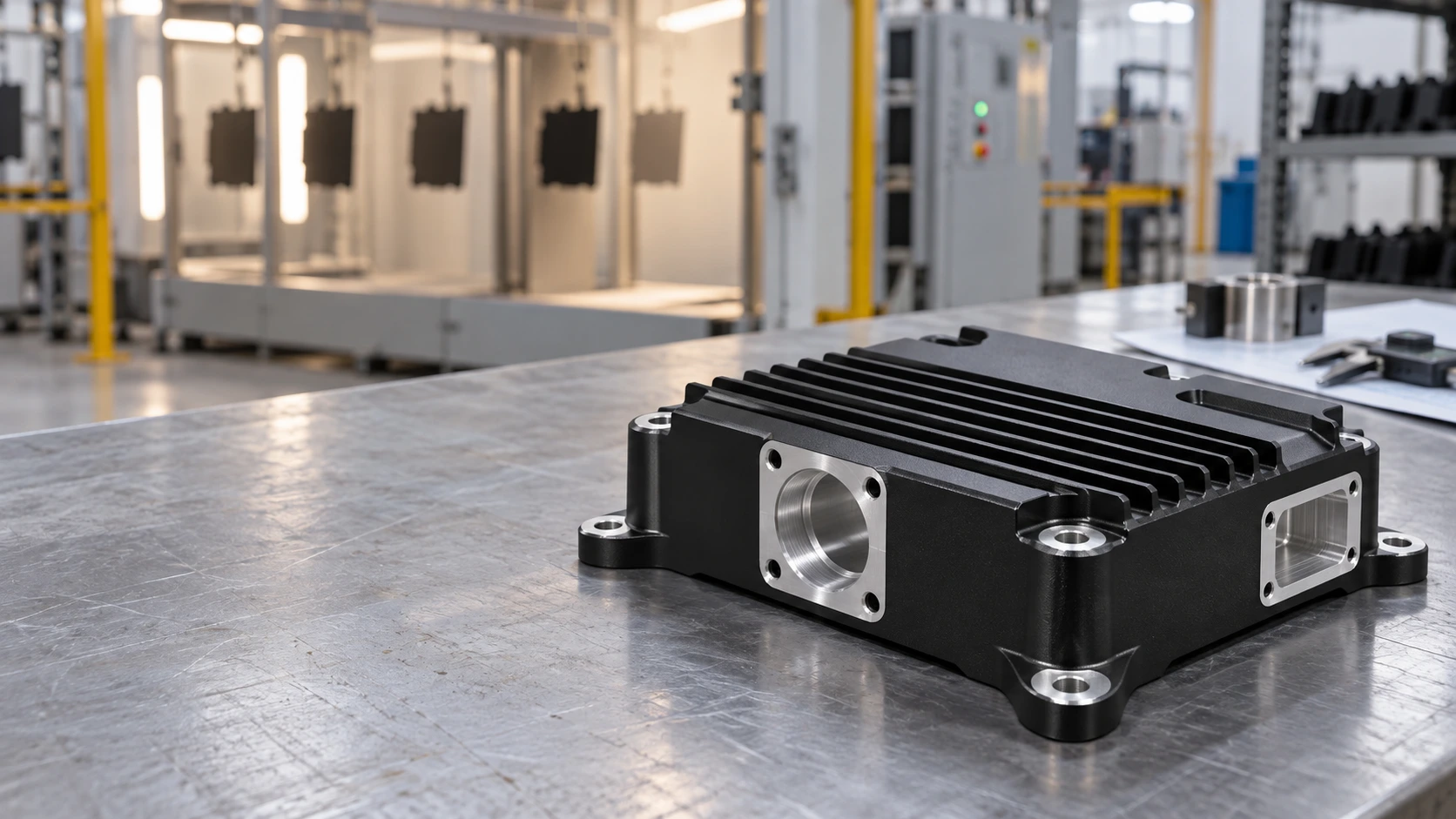
The decision to powder coat sheet metal components and enclosures may come up where OEM customers require more than just aesthetics from their components and enclosures. A powder coated component such as an enclosure, chassis, bracket, cover or frame needs to be tough enough to withstand handling, assembly, packaging, export, and use. In cases where coating chips off along edges, forms a buildup in threaded openings, or fails in just a few months in operation, this may not be a purely aesthetic problem.

Sourcing teams should look into powder coating in conjunction with sheet metal fabrication, welding, masking, surface conditioning, coating thickness, curing, and packaging.A good finish starts long before powder reaches the part.

What Is the Powder Coating Process for Sheet Metal Parts?

Surface Preparation Before Powder Coating

The first step in powder coating is a parts review. The engineer will review the drawing, material, cosmetic surface finish, hole placement, insert location, bends, and assemble points. When it comes to cold rolled steel, carbon steel, aluminum, stainless steel, galvanized sheet, and aluminum-zinc coated sheets, surface conditions greatly influence the adhesion of powder coating.


Surface preparation prior to powder coating includes either cleaning, degreasing, grinding, sanding, or shot blasting. Oil, welding residues, rust, sharp burr, and uneven grinding marks can all be evident from the finished product. In the case of powder coated sheet metal enclosures, a weld mark will be noticeable even on a large surface like a cover.

Masking, Electrostatic Spraying and Curing

After cleaning, the supplier should cover threaded holes, grounding points, bearing surfaces, PEM fasteners, assembly contact surfaces, and tolerance-sensitive slots. It is an easily overlooked step, but one that has direct effects on assembly. A layer that is satisfactory on the surface may cause problems if screws cannot be screwed in properly or panels don’t fit anymore.


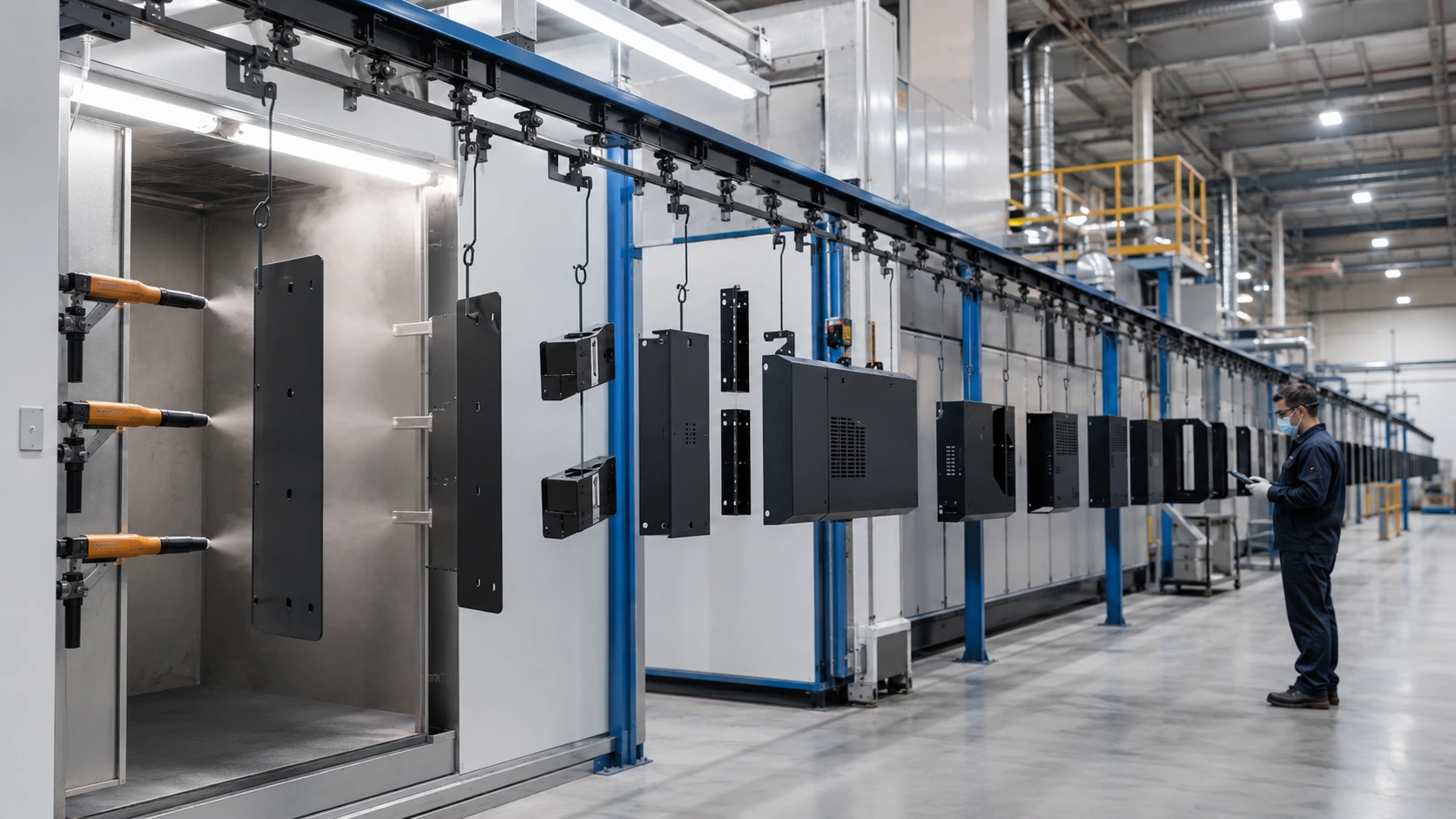
Powder coating with electrostatics involves charged powder particles adhering to metal pieces that are grounded. After the coating, the parts are baked in the oven, where the heat helps in making the film. In case of custom powder coated parts, the process validation steps involved are type of powder, color standard, texture, gloss, coating thickness, curing time, hanging of parts, and final inspection after cooling.

Materials Used for Powder Coated Sheet Metal Parts

Cold-rolled steel is widely used for equipment housings, medical equipment enclosure parts, electrical equipment enclosure panels, and indoor industrial covers. It forms well and accepts coating after proper cleaning. Powder coating cold rolled steel is common when buyers need a smooth appearance and controlled cost.

Aluminum sheet metal is preferred where weight reduction matters, such as communication boxes, covers, and control panels. Powder coating aluminum sheet metal requires careful pretreatment because poor cleaning can reduce adhesion. Stainless steel may be selected for cleaner environments or corrosion-sensitive applications, while galvanized steel and aluminum-zinc coated sheet are often used where base-metal corrosion resistance is part of the design.

Material choice should match the use environment. Indoor cabinets, semi-outdoor equipment, machinery covers, and high-touch panels do not face the same risks. Buyers should avoid choosing a material only by unit price.

Applications of Powder Coated Sheet Metal Enclosures

Powder coated sheet metal enclosures are used across medical equipment, security inspection equipment, industrial control cabinets, communication boxes, semiconductor equipment frames, electrical panels, agricultural machinery covers, and new energy equipment parts.

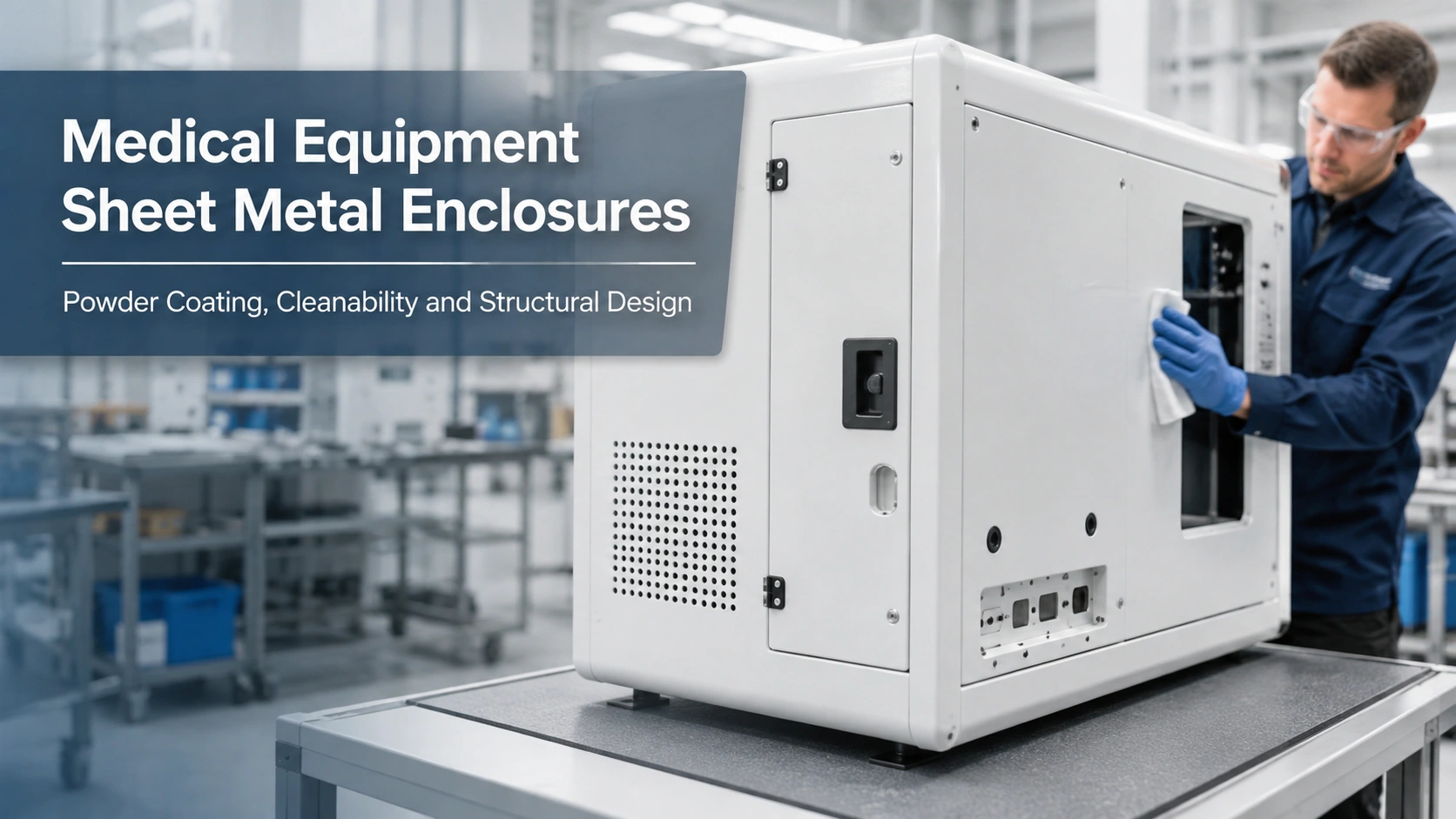
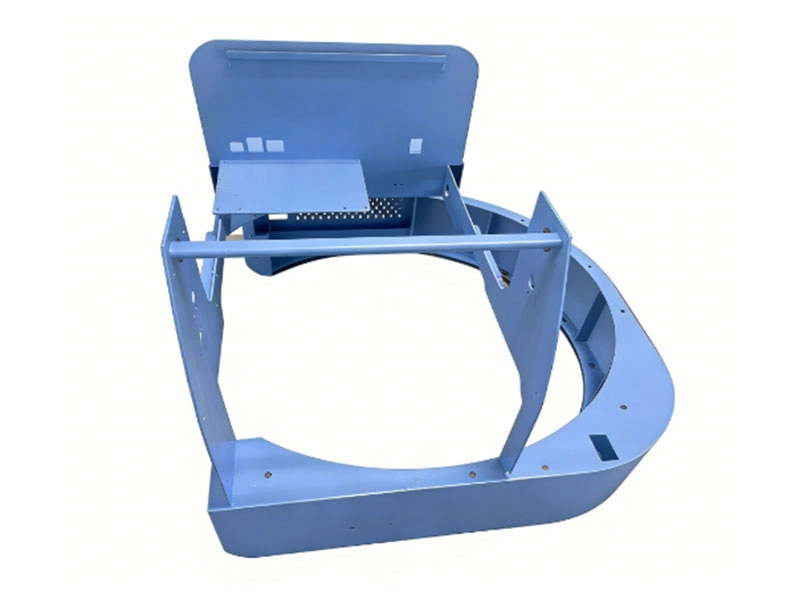
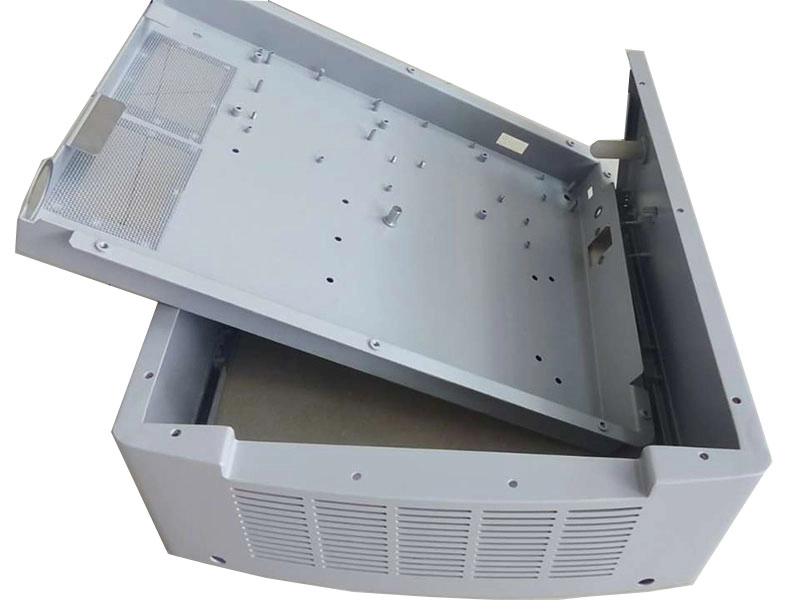
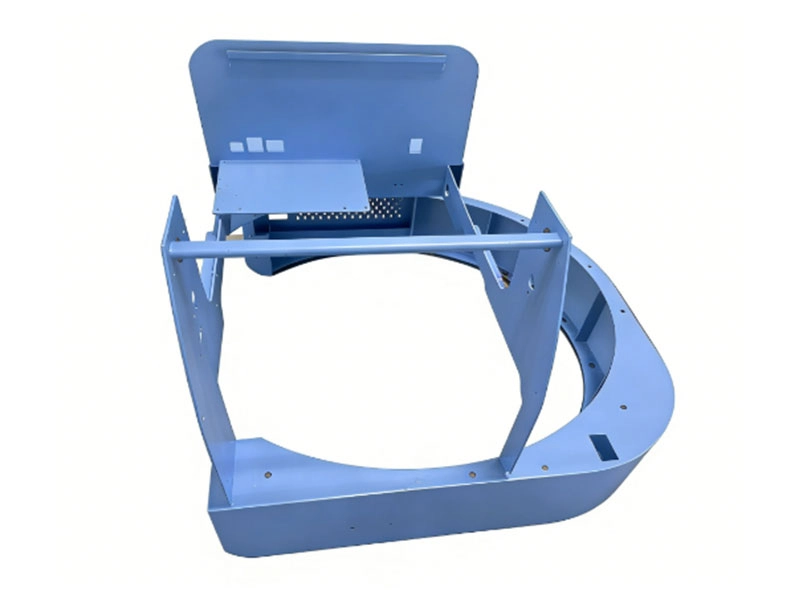
A medical equipment enclosure may require smooth curved forming, cleanable surfaces, integrated ventilation slots, and a stable light-colored finish. A security inspection chassis usually places more attention on strength, internal assembly, and surface durability. A semiconductor equipment frame may need a clean surface, stable geometry, and protection against corrosion during handling and installation.

For large sheet metal enclosure powder coating, part size and weight become major purchasing questions. Buyers should ask whether the supplier can handle large boxes, frames, and covers without damaging edges or creating uneven film build-up.

Powder Coating vs Painting for OEM Metal Finishing

Powder coating vs painting is a common decision for OEM metal finishing. Powder coating is often used for repeat production, durable surfaces, consistent appearance, and efficient batch processing. Wet painting may be considered for special color effects, very large parts, thin-film requirements, or cases where heat exposure must be limited.

The better choice depends on material, part size, function, color standard, finish texture, corrosion target, and annual volume. A practical RFQ should not simply say “black coating.” It should describe the color reference, gloss, texture, masking zones, cosmetic surface, coating thickness for sheet metal, salt spray expectation if required, packing method, and application environment.

Choosing a Sheet Metal Fabrication and Powder Coating Supplier

For buyers sourcing custom powder coated sheet metal parts in bulk, supplier capability is just as important as the powder itself. A qualified OEM sheet metal manufacturer should understand cutting, bending, welding, grinding, riveting, powder coating, painting, inspection, and packing as one connected workflow.

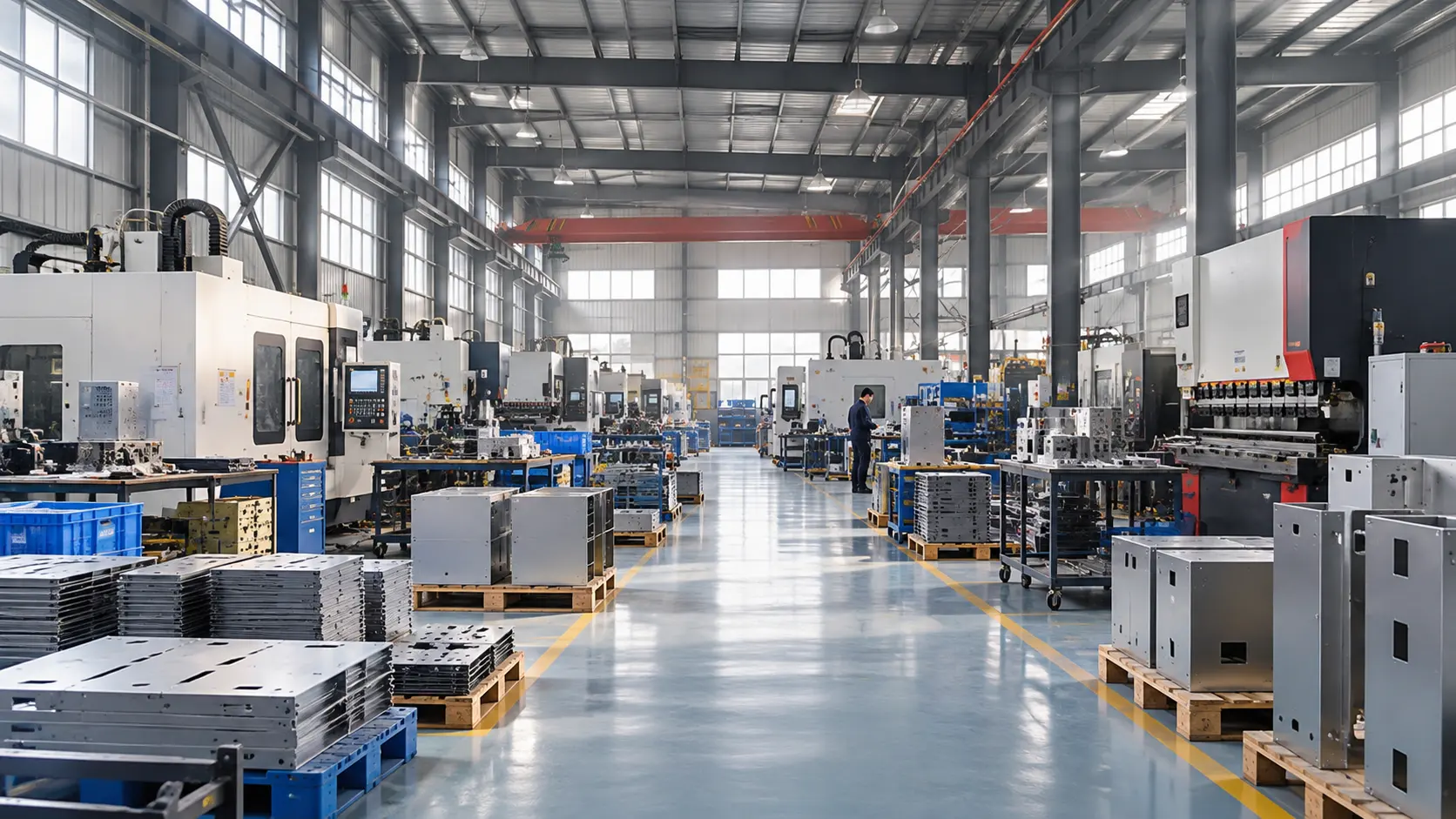
This is where Zhejiang Chuangkai Mechanical and Electrical Technology Co., Ltd. can support buyers looking for sheet metal fabrication and powder coating for equipment parts and enclosures. The company was established in 2003 and operates a standardized factory of about 13,500 square meters. Its manufacturing capability covers precision sheet metal processing, metal stamping, machining, surface painting, powder coating, and assembly.

The company’s powder coating and painting setup includes an automatic powder coating line, a manual powder coating line for large parts and large boxes, a manual painting line, and an automatic powder coating and painting hybrid line under construction. Its product experience includes medical equipment curved sheet metal enclosure, security inspection equipment chassis, communication box components, and equipment frames. Buyers can also learn more through precision metal manufacturing and assembly solutions or review about Zhejiang Chuangkai Mechanical and Electrical Technology Co., Ltd. before sending drawings.

Medical Equipment Curved Sheet Metal Enclosure

Quality control is also part of supplier selection. Zhejiang Chuangkai Mechanical and Electrical Technology Co., Ltd. uses inspection equipment such as CMM, 2.5D measuring equipment, metallographic inspection, and hardness testing, with quality practices covering process control, APQP, PPAP, PFMEA, 8D, and MES-based production management.

Conclusion

Powder coating works best when it is treated as part of the full OEM manufacturing route, not as a final decorative step. Buyers should review material, surface preparation, masking, coating type, thickness control, curing, inspection, and packaging before confirming production. For OEM projects involving enclosures, chassis, brackets, covers, and equipment frames, Zhejiang Chuangkai Mechanical and Electrical Technology Co., Ltd. provides integrated support from fabrication to finishing and assembly. To review drawings, coating requirements, samples, or RFQ details, buyers may contact the engineering team for practical manufacturing advice.

FAQs

Q1: What causes powder coating to peel off sheet metal parts?

A1: The powder coating can peel due to contamination of the metal part by grease, rust, oxide, welding residues, or insufficient pretreatment. Incomplete cure and incompatible coating material system with respect to the base material can also cause peeling of the coating from the metal surface. Surface preparation prior to powder coating is one of the first areas that need to be checked.


Q2: What should be included in my powder coating specifications for sheet metal enclosures?

A2: When specifying powder coating you will have to define material, drawing revision, color, gloss, texture, thickness of coating, masked areas, cosmetic areas, corrosion protection level, quantity, and packaging method. Marking of threads, grounding, and assembly surfaces is also important for powder coating of sheet metal enclosures.


Q3: Which process is better – powder coating or painting of custom metal parts?

A3: Powder coating is preferable to painting of custom metal parts if durability, repeatability, high volume production of parts is desired. Painting can be the better option if unusual finishes, very large parts, or thin film coating is required.


Q4: What materials can be used for powder coated sheet metal parts?

A4: Common materials include cold-rolled steel, carbon steel, aluminum, stainless steel, galvanized sheet, and aluminum-zinc coated sheet. Each material has different forming, welding, corrosion, and coating behavior. For OEM metal finishing, buyers should choose materials based on function, environment, appearance, and cost target.


Q5: How can buyers reduce coating problems before mass production?

A5: Buyers can reduce coating problems by providing complete drawings, marking masking zones, confirming coating thickness, checking sample parts before batch production, and selecting a supplier that understands both fabrication and finishing. Early review helps prevent blocked holes, poor adhesion, color mismatch, and assembly interference.


3rd July 2026

New Energy Equipment Metal Parts Manufacturer: Sheet Metal Fabrication & Powder Coating Guide

New Energy Equipment Metal Parts Manufacturer Sheet Metal Fabrication & Powder Coating Guide

The choice of manufacturers of metal parts for new energy equipment has now become a critical decision for OEMs who manufacture electronic power devices, chargers, equipment associated with batteries, energy storage cases, industrial controllers, and other mechanical structures.


Metal parts may seem to be very simple from the drawing perspective; however, in actual manufacturing, these parts require laser cutting, CNC punching, bending, riveting, welding, painting, inspecting, and assembling.


When buying metal parts in large quantities, what matters most for a buyer is not how well a supplier can produce a single sample part, but rather whether he or she can keep dimensions, paint quality, delivery time, and other factors consistent during the repeat production process.

What Metal Parts Are Used in New Energy Equipment?

New energy equipment uses many types of custom metal parts. Common examples include mounting plates, sheet metal brackets, protective housings, equipment covers, welded frames, electrical cabinet panels, heat dissipation components, connection plates, and support rails. Some parts are hidden inside the equipment, while others become visible outer covers that affect both performance and appearance.

Mounting Plates and Brackets

Mounting plates and brackets usually require accurate holes, slots, threads, and flatness control. A small hole-position error can cause problems during assembly, especially when electrical modules, terminals, rails, or heat dissipation parts need to be installed in a fixed position. For this reason, early drawing review is valuable before cutting or punching begins.

Protective Housings and Equipment Covers

Protective enclosures and coverings should be able to provide for structural considerations, ventilation, coating, and fit together during assembly. This is because in cases where a powder-coated cover is required, the bending edges, grounding, coating thickness near openings, and packing for shipping overseas need consideration.

Key Sheet Metal Fabrication Processes for Energy Equipment Parts

Sheet metal manufacturing that will guarantee reliable fabrication in terms of energy equipment requires appropriate match between the process used and part design, material, quantity, and finish. The supplier is supposed to make sure that the design is suitable for the fabrication process. It should not just go by the drawing.

Laser Cutting and CNC Punching

Laser cutting is often used for custom profiles, low-to-medium volume parts, and components with changing designs. CNC punching works well for repeated holes, louvers, ventilation slots, and standard mounting features. For energy equipment metal components, these two processes influence almost every later step. Poor cutting quality can create burrs, unstable hole sizes, or assembly misalignment after bending and coating.

When a part includes cooling slots or louvered ventilation areas, process planning becomes even more important. Buyers can review a related ventilation and heat dissipation sheet metal component to understand how CNC punching, bending, riveting, powder coating, and anodizing can be combined for power electronics and industrial equipment applications.Ventilation and Heat Dissipation Sheet Metal Component

Bending, Riveting and Assembly Fit

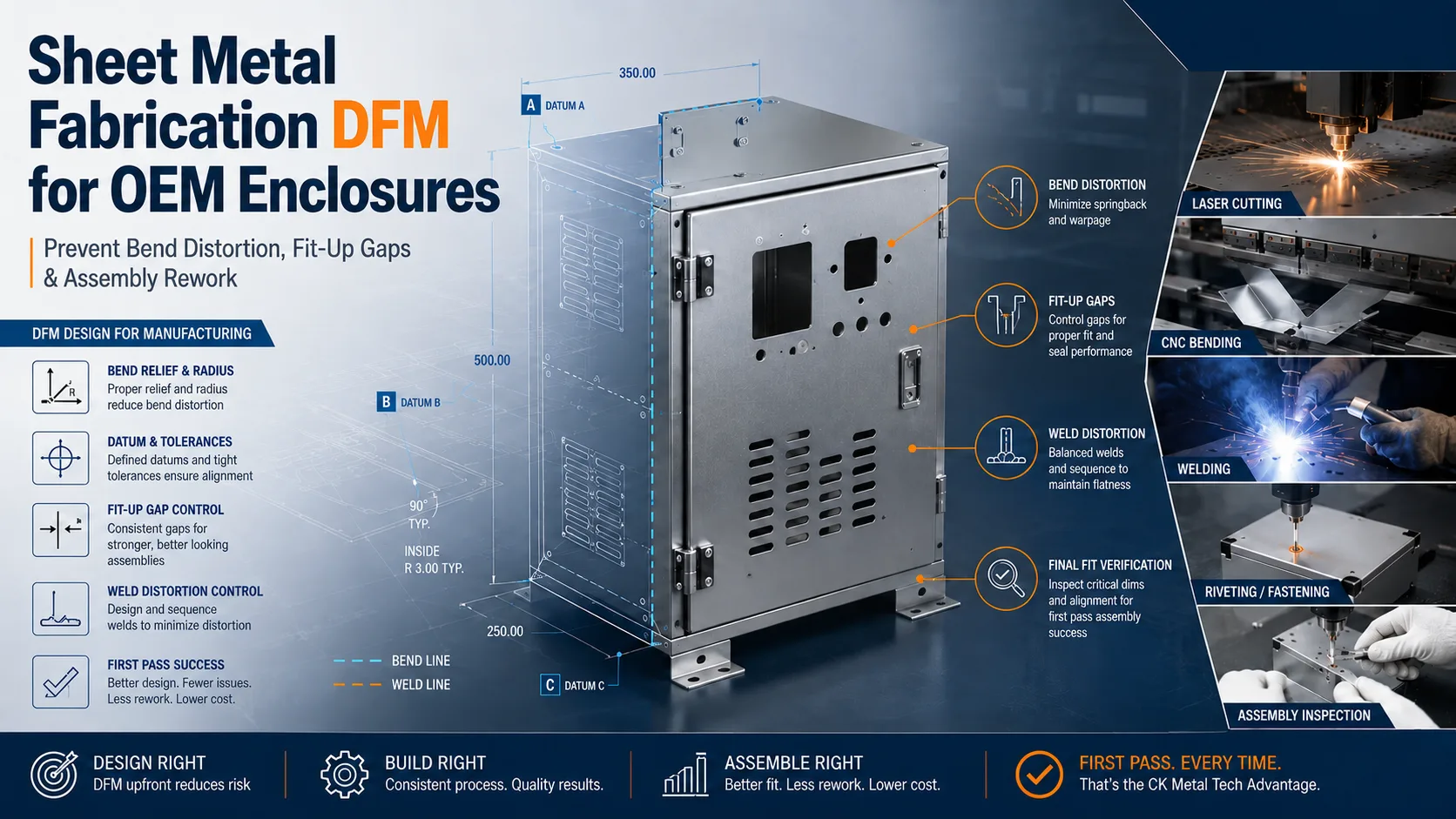
Bending determines the final shape of enclosures, covers, panels, and brackets. The bend radius, material thickness, hole distance from the bend line, and forming sequence all affect fit. Riveting is also common for threaded studs, nuts, and fastening points. If coating thickness is not considered early, threaded holes, grounding positions, and tight assembly areas may become difficult to use after finishing.

Welding and Grinding

Welding is often required for frames, reinforced covers, structural supports, and equipment housings. The main risks are heat distortion, poor fixture control, visible grinding marks, and coating defects around welded zones. For new energy equipment, welded metal parts should be checked not only for strength, but also for dimensional stability after grinding and powder coating.

For buyers comparing different equipment categories, this guide on custom sheet metal fabrication for OEM electrical, agricultural and new energy equipment parts explains how fabrication requirements change across electrical, agricultural, and new energy applications.

Why Powder Coating Matters for New Energy Equipment Metal Parts

Powder coating is widely used for new energy equipment metal parts because it provides a durable surface layer for protection, handling, and appearance consistency. It is especially useful for sheet metal covers, brackets, cabinet panels, frames, and outdoor or semi-outdoor equipment components.

A coating issue may not appear serious at first, but it can create real purchasing problems. A coating that is too thick may affect holes, slots, grounding points, or mating surfaces. A coating that is too thin may reduce corrosion resistance. Poor surface preparation can lead to peeling, weak adhesion, or inconsistent appearance after shipment.

The practical solution is to define coating requirements before production. Buyers should confirm color standard, gloss, texture, coating thickness if required, masking areas, cosmetic surfaces, salt spray expectations, and packaging method. When powder coating is planned together with fabrication, many problems can be avoided before the first production batch.

How to Choose Materials for New Energy Equipment Metal Parts

Material selection must coincide with strength requirements, weight, resistance to corrosion, cost, and surface finish considerations. The most common choice of material for brackets, covers, and powder-coated products would be carbon steel where strength and cost are important considerations. If cleanliness or higher corrosion resistance is needed then stainless steel would be chosen. The best material for light weight covers, panels and heat sensitive structures would be aluminum alloy. Material options for galvanized sheet and aluminum-zinc coated sheet would be considered for basic corrosion resistance before coating/assembly.


For OEM purchasers, material selection must go hand-in-hand with the manufacturing process. Easy to cut material may be hard to weld and coat. Light weight material can decrease the product weight but will increase the formability and surface treatability requirements. Early supplier evaluation minimizes re-engineering after sampling.

Common Purchasing Problems and How to Prevent Them

A frequent problem is that a sheet metal part passes dimensional inspection before coating but becomes difficult to assemble after powder coating. This usually happens when holes, slots, threads, or grounding points are not masked or when coating thickness is not considered in the drawing.

Another common issue is welding deformation. A frame may look acceptable after welding, but once it enters assembly, small angle or flatness errors can affect installation. This can be reduced through better fixtures, controlled welding sequence, suitable welding methods, and first-article inspection.

Surface damage during transportation is also common for powder coated energy equipment parts. Protective packaging should be planned according to part weight, coating surface, stacking method, and shipping distance. For exported OEM parts, packaging is part of quality control, not a final afterthought.

What to Check Before Choosing a New Energy Equipment Metal Parts Manufacturer

After understanding the key selection factors, it becomes easier to evaluate whether a manufacturer can support long-term purchasing needs. A qualified manufacturer should provide drawing review, material selection support, laser cutting, CNC punching, bending, welding, powder coating, inspection, sample production, and repeat batch manufacturing.

Zhejiang Chuangkai Mechanical and Electrical Technology Co., Ltd. supports OEM customers through integrated metal manufacturing, including sheet metal fabrication, precision stamping, CNC machining, welding, powder coating, painting, and assembly. For buyers who need a supplier with broader process coverage, CK Metal Tech precision metal manufacturing services can support custom projects from drawing review to finished metal components.

The above mentioned integrated approach to manufacturing is beneficial where the new energy equipment project involves various families of parts, such as powder coating cover, punched ventilation panel, welded frame, machined insert, and stamped bracket. It would be helpful to keep all these processes in one single supplier in order to avoid communication problems and quality responsibility issues.

Conclusion

Sourcing new energy equipment metal parts requires more than comparing unit prices. Buyers should review the material, fabrication route, bending accuracy, welding control, powder coating requirement, inspection method, and packaging plan before choosing a supplier. A reliable manufacturer should understand both the part drawing and the final equipment application.

For custom energy equipment metal parts, Zhejiang Chuangkai Mechanical and Electrical Technology Co., Ltd. can review drawings, materials, quantities, coating needs, and assembly requirements. Buyers can contact Chuangkai for a custom metal parts quote to discuss samples, production feasibility, and long-term supply requirements.

FAQs

Q1: How do I choose a new energy equipment metal parts manufacturer?

A1: Choose a manufacturer that can review drawings, recommend materials, control sheet metal fabrication, manage welding deformation, provide powder coating, and inspect parts before shipment. For OEM projects, process control and batch consistency are often more important than the lowest sample price.


Q2: What metal parts are commonly used in new energy equipment?

A2: Common new energy equipment metal parts include mounting plates, brackets, protective housings, cabinet panels, heat dissipation components, welded frames, support rails, connection plates, and powder coated covers. These parts are used in power electronics, energy storage systems, charging equipment, and industrial control units.


Q3: What are the benefits of powder coating for the metal parts used in energy equipment?

A3: Powder coating helps to achieve better results in terms of corrosion resistance, wear resistance, handling and uniformity of finish. Powder coating is frequently applied to sheet metal parts such as covers, brackets, frames, enclosures, and panels. Buyers need to define color, texture, glossiness, coating thickness, areas for masking and packaging.


Q4: How can issues with coating occur after sheet metal fabrication?

A4: Coating issues can be minimized by checking the surface preparation, areas for masking, grounding points, size of holes, coating thickness and curing requirements prior to production process. First article inspection and sample approval are also essential before production of batches.


Q5: Can a single supplier provide fabrication, welding and powder coating?

A5: Yes, there are companies that specialize in manufacturing of metal parts and can perform such operations as cutting, punching, bending, riveting, welding, coating and inspection in one production process.

2nd July 2026

Precision CNC Machining for Agricultural Machinery, Nuclear Power and Electrical Equipment Parts

From an OEM buyer’s perspective, creating an accurately machined part according to a drawing or blueprint is only the beginning. Such parts must assemble properly, withstand different types of load, resist operational defects, and remain stable through subsequent manufacturing steps. Agricultural equipment parts are often subjected to shock, severe vibration, mud, twisting torque, and long hours of outdoor operation, while nuclear power equipment and new energy equipment require accurate dimensional control, closely managed production processes, and clear part-related documentation. Electrical equipment parts often require accurately drilled holes, machined threads, precision ground surfaces, and reliable assembly details.

To produce metal parts properly, a CNC machined parts supplier must first understand the application requirements behind the drawing. Zhejiang Chuangkai Mechanical and Electrical Technology Co., Ltd. supports OEM buyers as a one-stop precision metal manufacturing partner, combining precision CNC machined parts with metal stamping, sheet metal fabrication, surface finishing such as powder coating or painting, and assembly under one production roof.

Precision CNC Machining for Agricultural Machinery, Nuclear Power and Electrical Equipment Parts

Why OEM Buyers Need More Than Basic CNC Machining

Just because a part has been CNC machined and has passed dimensional checks does not mean it will last in service. A simple-looking shaft, for example, may have the correct outside diameter, but poor transitions between sections, incorrect material hardness, a rough surface, or shaft geometry that creates areas of high stress concentration can all cause premature fatigue failure. A machined bracket for electrical equipment may also look straightforward to manufacture, but a small error in the location of a single hole could create major assembly problems if the bracket does not align with other metal parts and components.

This is why custom CNC machined parts need engineering review. In the agricultural industry, machined shafts, pins, sleeves, and transmission parts are subjected to varying levels of stress and load. For the electrical market, precision machined metal parts require clean cut edges, accurate threaded holes, and stable mounting surfaces. For nuclear power and new energy equipment-related metal components, repeatability and process control are just as important as final dimensional accuracy.

Key CNC Machining Processes for OEM Metal Parts

CNC Turning for Shafts, Sleeves and Round Parts

CNC turning is typically used to manufacture shafts, sleeves, pins, flanges, and other round components used in agricultural machinery, electrical components, and power transmission-related machinery. Particular attention should be paid to concentricity, outside diameter, thread accuracy, end face quality, and surface finish, since these factors affect rotation, wear, sealing, and assembly.

Chuangkai provides precision CNC machining services for custom shafts and other precision turned parts used in OEM metal parts. For parts used in field machinery or power-related products, a stable machining process and proper inspection are important to avoid unexpected problems such as poor fit during mass production.

CNC Milling for Plates, Brackets and Complex Features

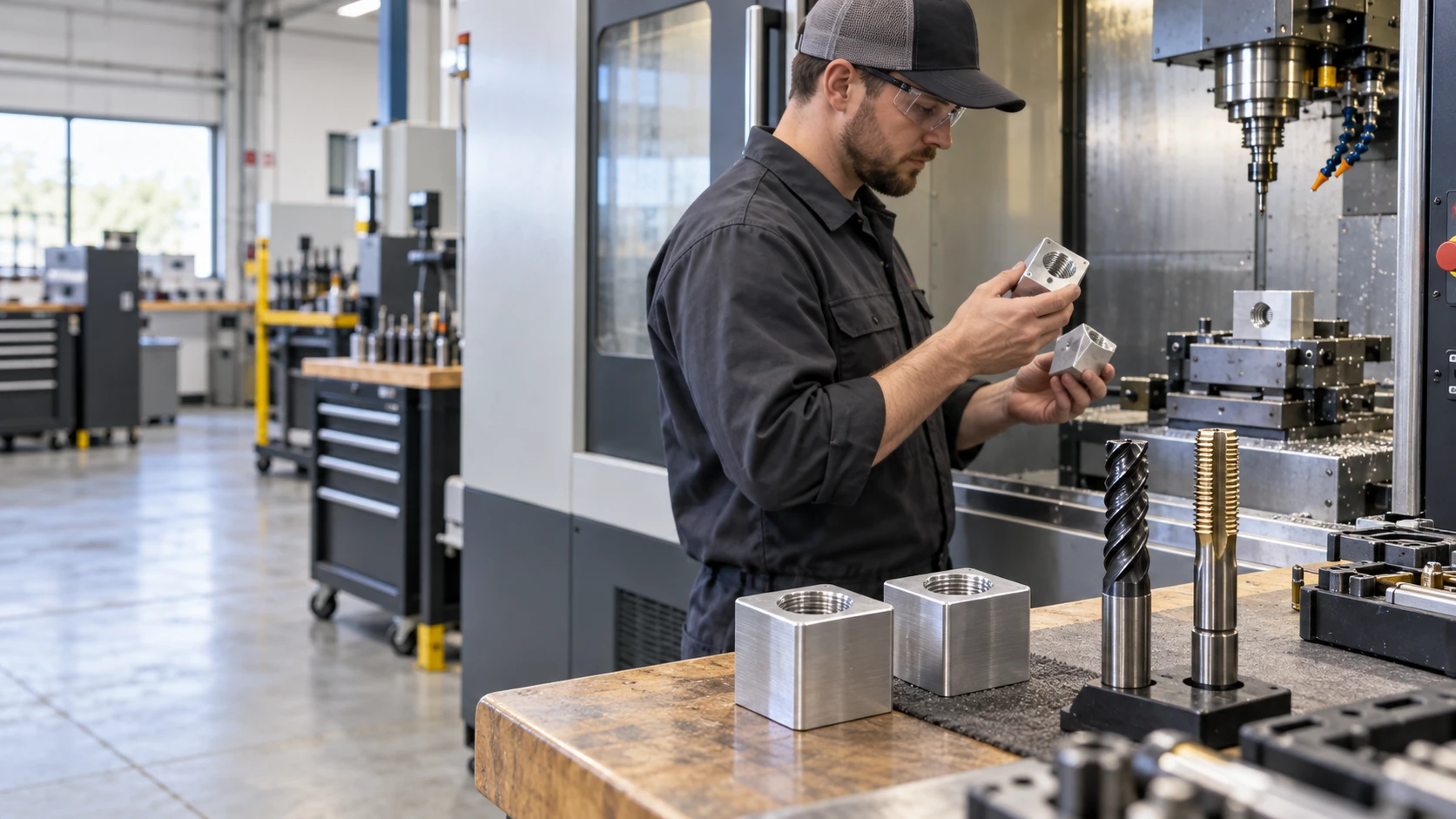
CNC milling is suitable for machined plates, mounting blocks, precision brackets, housings, slots, flat surfaces, and complex profiles. For electrical equipment parts, CNC milling is especially useful when hole relationships and thread depth affect final assembly. For nuclear power and new energy equipment-related metal parts, CNC milling is suitable for applications that require high flatness, accurate hole location, proper edge treatment, and stable surface quality for installation and long-term use.

A good supplier of machined plates first reviews whether milling, turning, drilling, tapping, or grinding is the most effective method for producing the part. If the machined plate also needs to work with sheet metal parts, stamped details, coating, or final assembly, integrated production can avoid excessive handovers and communication failures between vendors.

Grinding, Thread Rolling, Tapping and Drilling

In addition to primary machining processes, a part’s ability to assemble correctly is often determined by secondary machining processes. Grinding can improve surface finish and dimensional precision. Thread rolling can create stronger and more consistent threads in suitable applications. Tapping and drilling must be carefully controlled when creating threaded holes, mounting holes, and other fastening points.

These processes should not be treated as simple add-ons to OEM CNC machining services. They are part of the complete production route, especially when machined parts must be connected to stamped parts, sheet metal parts, or coated assemblies.

CNC Machining for Agricultural Machinery Parts

Precision CNC Machining

Agricultural machinery parts are often judged by durability. Shafts, pins, gear shafts, sleeves, supports, connectors, and other CNC machined agricultural parts are used in demanding working environments. These parts may face mud, dust, shock, rain, and long-term outdoor operation. While a low machining price may appear attractive, it offers little value if the part wears out or fails in the field.

When purchasing machined shafts for agricultural machinery, buyers should check samples for material, heat treatment, hardness, surface roughness, transition radius, and critical load-bearing areas. Many fatigue failures are not caused only by the material itself, but also by the working conditions the shaft must withstand. An experienced machined components supplier can identify potential problems before heat treatment, tooling, or batch production begins. Drawing review based on past production experience can reveal possible risks before they become costly.

CNC Machining for Nuclear Power and New Energy Equipment Parts

Metal parts for nuclear power and new energy equipment usually require fixed dimensions, clean surfaces, fixed lot numbers, and clear inspection standards. Typical components include mounting plates, precision brackets, shafts, connectors, structural metal parts, covers, and support-related machined parts.

For these types of parts, buyers should clearly define material grade, major dimensions, tolerance, surface finish, packaging, and batch traceability before production begins. A controlled workflow is critical for CNC machining of nuclear power equipment parts and new energy equipment metal parts, because late changes may affect assembly, inspection, and on-time delivery.

CNC Machined Parts for Electrical Equipment

Many electrical equipment parts require accurate mounting features, smooth threaded connections, stable surfaces, and consistent assembly dimensions. Metal brackets, electrical connection blocks, electrical equipment support rails, sleeves, electrical equipment mounting plates, and small precision parts are common examples.

Before production starts, it is important to verify hole tolerances, thread depth, burr requirements, chamfers, plating or coating needs, and final assembly clearance. If CNC machined electrical parts are combined with stamped parts or sheet metal housings, supplier coordination must be carefully managed. A one-stop manufacturer can align machining, surface finishing, and assembly requirements within one production system.

From Prototype to Stable CNC Machining Production

Creating a prototype CNC machined part is only the beginning. A sample part may meet drawing requirements, but later mass production may still face problems such as tolerance drift, tool wear, packaging damage, thread fitting issues, or heat-treatment variation. Planning for stable production must begin at the earliest stage.

Before CNC machining begins, a reliable CNC supplier should confirm several critical factors for the buyer, including material, key dimensions, tolerance, surface finish, heat treatment, threads, chamfers, inspection methods, and packaging details. First article inspection, in-process inspection, key dimension records, and corrective procedures all help keep production quality consistent. For buyers used to working with different low-volume CNC machining companies, this level of discipline is what separates a job shop from a repeat production supplier.

How Quality Control Reduces CNC Machining Risk

Quality control for CNC machining does not end with final inspection. It begins with drawing review and continues through fixture planning, tool selection, part setup, first-piece inspection, in-process checks, and final verification.

Zhejiang Chuangkai uses quality management methods and inspection resources to check precision machined parts. Its precision inspection tools include coordinate measuring machines, 2.5D measuring machines, metallographic testing, hardness testing, and other inspection resources. Chuangkai also applies process control methods such as APQP, PPAP, PFMEA, and 8D, with production managed through MES. For OEM buyers evaluating suppliers, Zhejiang Chuangkai’s factory scale, certifications, and complete production line provide useful background for supplier assessment.

How to Choose a Precision CNC Machining Supplier

A precision machining parts supplier should be able to provide more than CNC turning and milling. Buyers should review whether the factory can also complete Swiss-type machining, grinding, thread rolling, tapping, drilling, polishing, surface finishing, and related secondary processes. The supplier should also have experience manufacturing parts for agricultural machinery, nuclear power and new energy equipment, and electrical equipment.

When choosing a custom machined parts manufacturer, buyers should consider process range, material experience, inspection capability, quality system maturity, engineering feedback, and stable communication. Chuangkai offers precision machining as well as stamping, sheet metal fabrication, coating, and assembly. For OEM customers that require more than one process to manufacture their parts, Chuangkai can provide one-stop production support. The company can accept buyer drawings, buyer samples, or new development projects, and can provide machining review before production planning begins.

Conclusion

When it comes to precision CNC machining for agricultural machinery parts, nuclear power parts, and electrical equipment parts, selecting a supplier based only on machining price is not a wise approach. OEM buyers need suppliers that understand working conditions, material properties, machining processes, and repeat production requirements. A qualified supplier should also have strong quality control processes from prototype to mass production. With machining, inspection, finishing, and assembly capabilities under one roof, a supplier can reduce risk and improve consistency, lead time, and supplier accountability.

FAQs

Q1: How do buyers choose a CNC machining supplier for agricultural machinery parts?

A: Buyers should check whether the supplier understands field conditions such as vibration, impact, mud, torque, and fatigue. For machined shafts and agricultural equipment components, material selection, heat treatment, hardness, surface roughness, radius design, and batch inspection are important.


Q2: What CNC machining processes are used for electrical equipment parts?

A: Electrical equipment components may require CNC turning, CNC milling, drilling, tapping, grinding, thread rolling, and surface finishing. Whether the part is a shaft, sleeve, bracket, mounting plate, connector, or small precision metal component, the correct process should be selected according to the part structure and assembly requirements.


Q3: What should be checked before CNC machined parts go into mass production?

A: Before mass production begins, the buyer should confirm the material grade, major dimensions, allowed tolerance, surface roughness, threads, chamfers, heat treatment, hardness, coating requirements, inspection methods, protective packaging, and batch records.


Q4: Why do CNC machined shafts fail in agricultural machinery?

A: CNC machined shafts can fail for many reasons. Common causes include fatigue, local stress concentration, improper heat treatment, uneven hardness, poor surface roughness, inadequate radius design, and harsh operating conditions. Shaft failure should not be attributed only to material.


Q5: Can one supplier handle CNC machining, surface finishing and assembly?

A: One supplier can handle CNC machining, surface finishing, and assembly when it has internal machining equipment, inspection capability, coating resources, assembly support, and quality management systems. This approach can reduce supplier coordination and improve production stability.


26th June 2026

Custom Metal Stamping and Tooling for High-Volume Precision Parts: A Supplier Selection Guide

OEM buyers purchasing high-volume precision parts often look beyond the lowest price per part. A reliable custom metal stamping project depends on several key factors, including stable tooling, proper material selection, precise dimensions, and controlled production from the sample phase through mass production. For electrical components, agricultural equipment parts, and new energy equipment metal parts, a small burr, excessive springback, or misaligned hole can cause assembly problems across an entire batch.

This is why supplier selection is so important early in the process. A stamping parts supplier should be able to review drawings, design and manufacture tooling, test materials, control tolerances, and support downstream processes such as CNC machining, surface finishing, and assembly. The capabilities of Chuangkai precision metal manufacturing, an experienced stamping supplier, can bring value to OEM purchasing teams that need to reduce supplier handoffs and maintain more stable production.

Custom Metal Stamping and Tooling for High-Volume Precision Parts A Supplier Selection Guide

Why High-Volume Precision Parts Need More Than Basic Stamping

High-volume metal stamping is not simply forming sheet or strip metal into a specific part shape. The part shape must be repeated thousands to millions of times while maintaining functional dimensions. In the electrical field, parts such as contact points, connector parts, holding clips, brackets, shielding parts, and mounting plates are typically stamped from metal. These parts often require sharp, clean cut edges, accurate hole locations, flat surfaces for electrical contact, and good spring properties.

Industrial parts for agricultural machinery, industrial equipment, and new energy equipment metal components demand different characteristics from purely aesthetic parts. For industrial parts, strength, fatigue resistance, material thickness, and coating compatibility are often the main concerns. For later assembly, stable dimensions, traceable quality, and consistent surface condition are also critical. What may seem like a minor variation on a single part can become very expensive on high-volume stamped metal parts.

Key Metal Stamping Processes for OEM Parts

Progressive Die Stamping for Large Production Runs

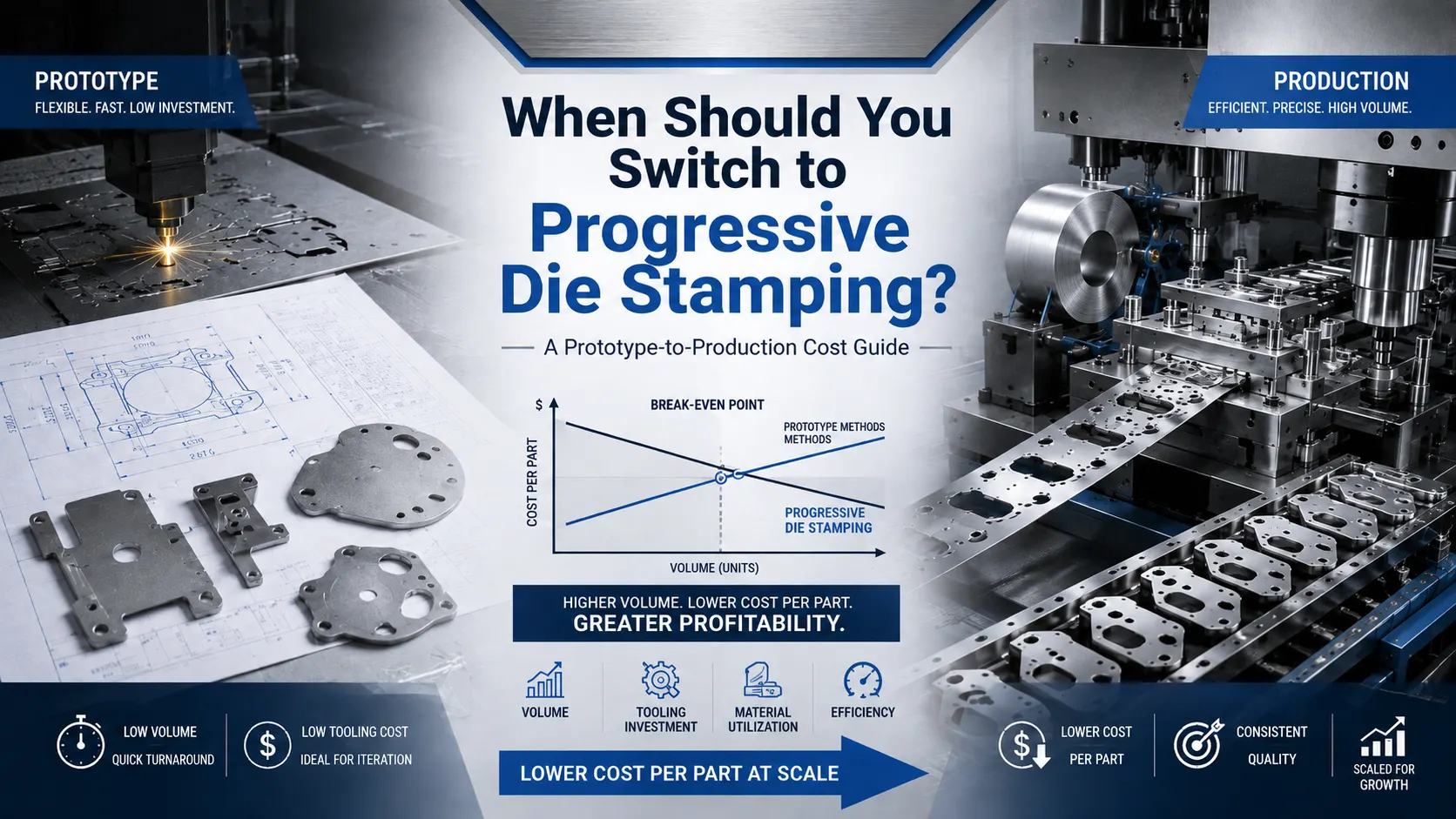
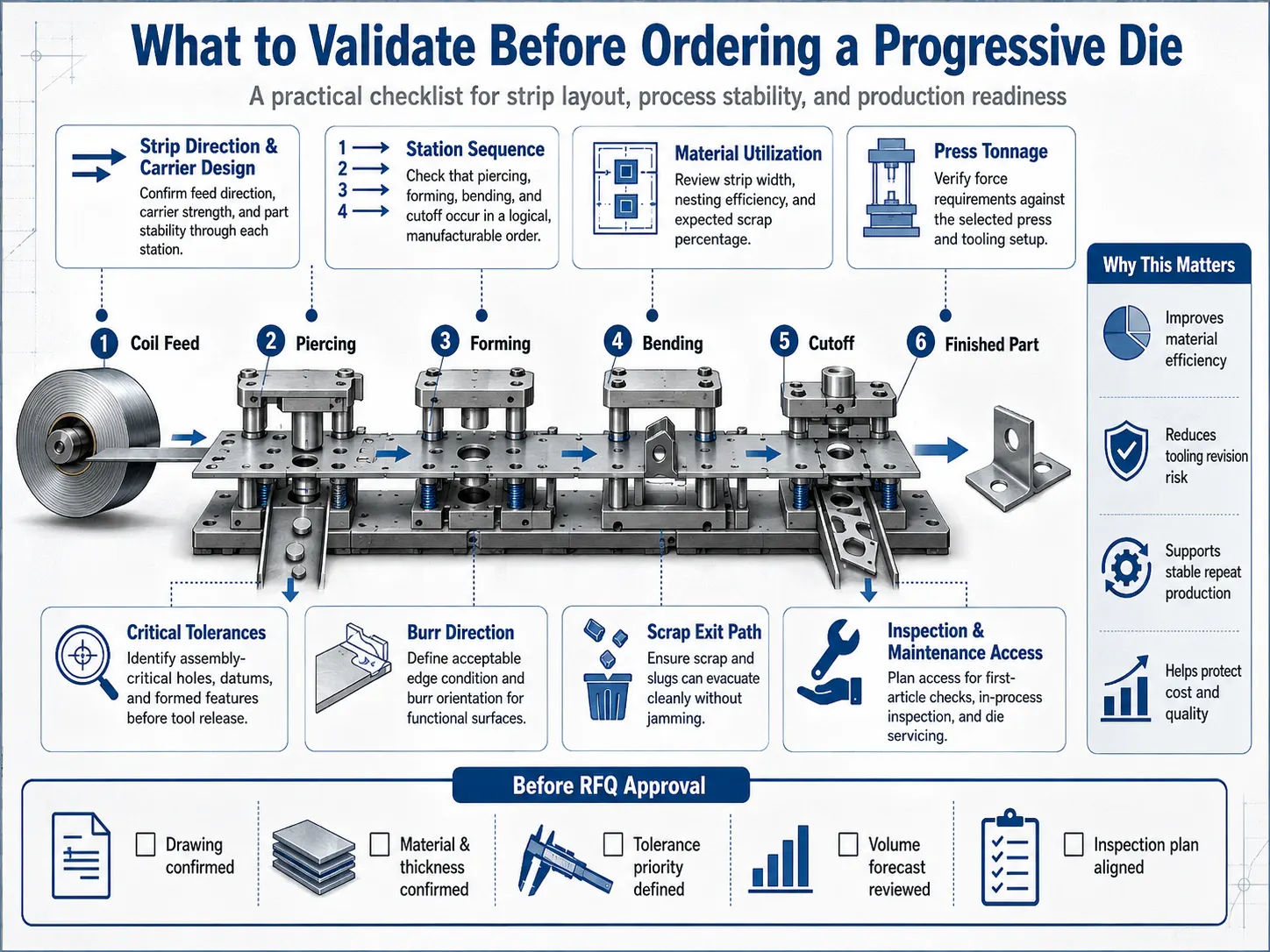
Progressive die stamping is a process used to produce large volumes of parts with repetitive features. In progressive die stamping, the metal strip passes through a number of die stations where different actions, such as punching, bending, forming, and cutting, are performed. Many connector parts, terminals, clips, brackets, and small structural parts are made by progressive die stamping because they require repeated features and consistent precision.

The main advantage of progressive die stamping is production efficiency. Once a die is set up correctly and runs properly, it can deliver cost-effective unit pricing and consistent quality for large batch sizes. Correct strip layout, forming sequence, and die clearance are essential to prevent problems such as burrs, material waste, and inconsistent dimensions in high-volume production.

Deep Drawing Stamping for Formed Metal Parts

Deep drawing stamping is a forming method used for parts with greater depth, multiple bends, or cup-like shapes. Deep drawing is often used to make shells, covers, sleeves, and other special formed metal parts produced to specific dimensions and tolerances. Deep drawing can present several inherent risks, including cracking, wrinkling, uneven wall thickness, and excessive springback. These risks must be reviewed before the first trial part.

Drawing may reduce welds that were originally specified for welded assemblies, improve sealing, and lower overall production cost. This possibility should be investigated during the design review stage, not after tooling has already been created.

Compound Die Stamping for Precision Features

In compound die stamping, blanking, punching, and other features are completed in one stroke of the press. For highly precise metal stamping production, the positional relationship among holes, edges, and profiles is critical. Compound dies can help improve feature accuracy and reduce handling between separate operations.

Common Materials Used in Custom Metal Stamping

Material selection for electrical stamped parts affects forming behavior, tool wear, springback, conductivity, corrosion resistance, and cost. Conductive, elastic, and corrosion-resistant materials are commonly used for connector parts, contact pieces, shielding parts, and precision clips. Common materials include brass, phosphor bronze, beryllium copper, nickel silver, stainless steel, and nickel strip.

Common materials used for agricultural machinery, industrial equipment, and structural stamped parts include carbon steel, low-carbon steel, cold-rolled steel strip, pre-plated steel, spring steel, stainless steel, and aluminum alloy. Depending on strength, formability, plating requirements, and cost targets, buyers can choose the most suitable material. Chuangkai can process a wide range of materials to make custom stamped metal parts, allowing engineers to select materials based on part function without unnecessary limitations.

How Tooling Design Affects Cost, Tolerance and Production Stability

Tooling is a critical component in high-volume metal stamping. The die affects burr direction, cutting clearance, material usage, springback, part forming sequence, production rate, and tool life. Although lower tooling cost may be attractive during purchasing, poor tooling design can result in increased scrap, lower output, higher maintenance costs, and eventual delays.

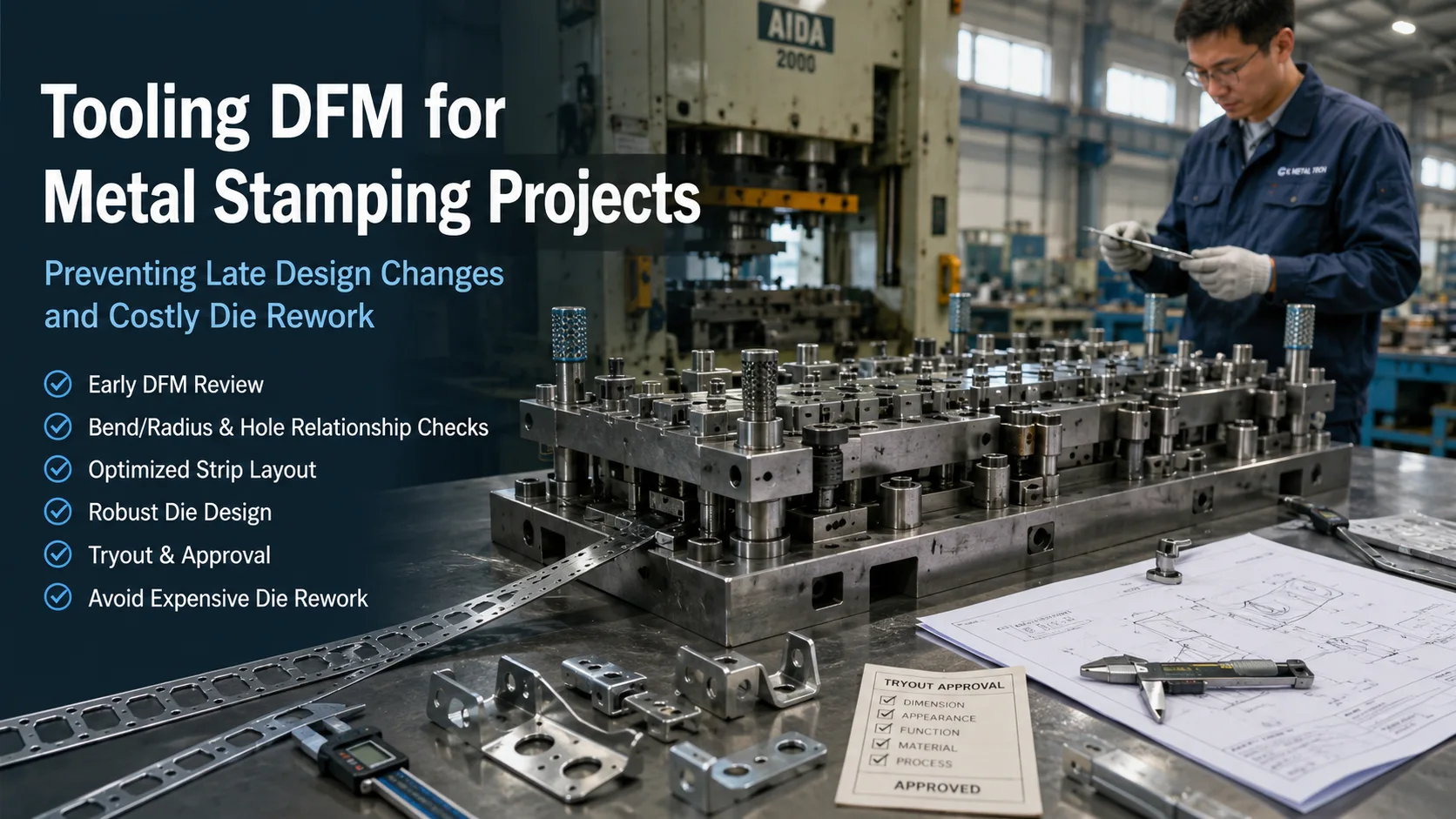
A more effective approach is to request manufacturability review and feedback from the supplier. This includes reviewing the proposed part for bend radius, hole-to-edge distance, material thickness, grain direction, tolerance requirements, and opportunities to reduce secondary processing. Chuangkai provides custom metal stamping and tooling services. With expertise in precision tooling design and manufacturing, Chuangkai supports customers from design to production. The company manufactures progressive stamping dies, drawing dies, and compound dies in-house. Its in-house tooling capability connects the design phase with production feasibility.

Fan Heat Dissipation Stamping Blade

Tolerance Control and Quality Problems in Precision Metal Stamping

Common metal stamping defects include burrs, cracks, deformation, springback, hole out-of-roundness, hole location deviation, surface dents, plating damage, and unexpected material behavior. These defects are usually caused by a combination of factors. Tool wear, die clearance, material hardness, lubrication, and process verification all need to be controlled to produce consistent stamped parts.

Tolerance management must begin before mass production starts. The supplier should carry out trial runs, first article inspection, key dimension checks, process control, and proper tool maintenance. Chuangkai supports stamping quality management with inspection equipment such as coordinate measuring equipment, 2.5D measuring equipment, metallographic testing equipment, and hardness testing equipment. Quality methods such as APQP, PPAP, PFMEA, 8D, process control, mistake prevention, and MES-based production management are also applied. These systems help OEM buyers reduce uncertainty in repeated production.

How to Reduce Cost in High-Volume Metal Stamping

When trying to reduce the cost of custom metal stamping, simply getting a lower unit price is not always the best way to save. Greater savings often come from better material usage, fewer secondary processes, longer die life, less scrap, and faster production. Progressive die stamping may require a larger upfront tooling investment, but for stable high-volume parts, it can reduce long-term cost per part.

Cost can also be reduced through design changes. For example, a bracket may become easier to form by changing the bend radius. A connector clip may have fewer quality issues if burr direction is considered before tooling. A stamped part may avoid additional machining if holes and part forms are planned correctly. For this reason, buyers should obtain DFM feedback before approving tooling.

How to Choose a Custom Metal Stamping Supplier

A good OEM metal stamping supplier should have in-house tooling capability, experience with different stamping materials, high-speed press equipment, trial production support, inspection capacity, and long-term batch production control. For projects involving electrical parts, agricultural machinery components, and new energy equipment metal components, the supplier should also understand how the stamped part will be assembled, coated, or combined with machined or sheet metal parts.

Zhejiang Chuangkai Mechanical and Electrical Technology Co., Ltd. was established in 2003 and has built an integrated manufacturing system covering precision tooling, precision metal stamping, sheet metal fabrication, CNC machining, surface coating, and assembly. With standardized workshops, quality system certifications, and high-speed precision stamping equipment, information about Zhejiang Chuangkai is relevant for OEM buyers evaluating long-term production suppliers. Buyers with drawings or samples can send drawings for a stamping review before tooling approval.

Conclusion

Press capacity for producing high-volume precision parts is only one factor to consider when selecting a metal stamping supplier. A qualified supplier also needs the ability to design tooling, understand suitable materials, hold close tolerances, maintain strong quality control, and support high-volume production. For OEM buyers, this means fewer supplier changes, fewer quality issues, and lower risk of supplier-related delays between sample approval and repeat production. As an integrated provider of custom stamping, tooling, machining, finishing, and assembly services, Chuangkai is a suitable partner for precision stamped parts requiring practical engineering input and timely delivery.

FAQs

Q1: How do buyers choose a custom metal stamping supplier for high-volume parts?

A: Buyers should assess whether the supplier has in-house tooling design, suitable press equipment, experience with appropriate materials, trial production capability, quality inspection processes, and efficient mass production management. Above all, the custom metal stamping supplier should be able to review drawings for potential manufacturing problems before tooling is produced.


Q2: What materials are commonly used for metal stamping parts?

A: Common metals used in metal stamping include stainless steel, aluminum alloy, brass, phosphor bronze, beryllium copper, nickel silver, low-carbon steel, cold-rolled steel, pre-plated steel, and spring steel. The specific material depends on conductivity, strength, elasticity, corrosion resistance, formability, and cost.


Q3: What is progressive die stamping used for?

A: Progressive die stamping is used to make high-volume precision parts such as terminal parts, connector parts, clips, brackets, mounting plates, and other small stamped metal parts. A progressive die is suitable for buyers who require fast production, precise dimensions, and lower unit cost after tooling is approved.


Q4: How can burrs and springback be controlled in precision metal stamping?

A: Burr size and springback can be controlled through die clearance, part material, tooling design, tryouts, process checks, and tool maintenance. For suppliers producing close-tolerance parts, it is often better to check multiple key dimensions throughout production rather than relying only on first sample approval.


Q5: How can buyers reduce the cost of custom stamped metal parts?

A: Buyers can reduce costs through early DFM review, better strip layout, improved material usage, progressive die tooling, fewer secondary processes, lower scrap, and consistent batch quality. A one-stop metal stamping and tooling supplier can also save time and reduce costs when machining, surface coating, or assembly is required.


25th June 2026

Custom Sheet Metal Fabrication for OEM Electrical, Agricultural and New Energy Equipment Parts

OEM buyers need more than just simple cutting and bending. One part of electrical equipment, agricultural machinery or new energy equipment could involve laser cutting, CNC punching, bending, riveting, welding, grinding, surface finishing, sand blasting, powder coating, painting, inspection and assembly. All these processes can be separated and handed over to different suppliers. As a result small delays and differences in quality can quickly lead to late launch, higher logistics costs and uncertainty as to who is responsible when a part does not fit.

For many purchasing departments, there is now a real need to source an integrated sheet metal fabrication supplier rather than a variety of single-process workshops. In terms of cost, purchasing metal in bulk at the lowest price per part is the primary goal; in terms of management, the main objective is to reduce the number of contacts required to manage the supplier. Above all, the aim is to cut lead times, improve inter-batch consistency, and ensure that producing custom OEM sheet metal parts as drawings, is made as easy as possible and remains stable over time in production.


Custom Sheet Metal Fabrication for OEM Electrical, Agricultural and New Energy Equipment Parts

Why OEM Buyers Need More Than Basic Sheet Metal Cutting

Different types of products demand different things from their fab partner. Electrical metal parts for example may require precise sized holes, square cut edges, strong mounting points and a good surface finish post fabrication that allows for reliable assembly. A small error in hole positioning can cause problems with mounting of terminals and brackets.

Sheet metal parts for agricultural machinery and new energy equipment have very different fields of application. On the one hand, there is the possibility of vibration and outdoor use, on the other, exposure to mud and impacts. Furthermore, many of these parts are subject to mechanical stress, which is constantly changing. While strength, the quality of the welds and the coating as well as the design of a part are crucial for agricultural machinery, the appearance of the part is less important for new energy equipment metal parts. They primarily require constant dimensions on the surface, effective surface protection and process control for identical parts in different batches. Parts are used in frames, mounting plates, brackets, covers and protective housings.

A supplier who understands these use cases can review drawings before production, can point out issues with the part’s manufacturability, and can select a better production route before the costs of creating tooling, welding, or coating are “stuck” in production.

Key Processes in Custom Sheet Metal Fabrication

Laser Cutting and CNC Punching

Laser cutting is typically used to make custom industrial sheet metal parts, such as those with complex shapes, with holes, slots, etc. or for low-to-medium volume production. CNC punching is used to make parts with lots of repetitive features. For OEM sheet metal parts, this is the first stage of production and can have a large impact on the rest of the process. Inaccurate cutting can cause problems when bending, cause parts to not fit together, and lead to additional work when coating the part.

The sheet metal workshop of Chuangkai offers a variety of different materials. So stainless steel, carbon steel, silicon steel, aluminum alloy, galvanized sheet and aluminum-zinc coated sheet are offered for custom sheet metal fabrication. For production of various sheet metal components such as electrical equipment metal parts, machinery sheet metal parts and other industrial metal parts custom fabrication can be of value when different strength, weight and corrosion resistance and cost targets have to be achieved.

Bending, Forming and Riveting

Bending creates angles, checks for flatness and for fit. A seemingly simple part such as a bracket can fail to assemble if the bend radius, the material thickness or the forming sequence has not been thought out. As mounting holes and edges are bent, they must remain rigid to match up with other parts that have been machined or otherwise formed as sheet metal. For projects such as electrical equipment and machinery, it is crucial to plan ahead for the bending process.

Riveting is typically used to secure threaded inserts, nuts, studs and other fastening points. Rather than using unnecessary welding, properly riveting these areas helps to reduce heat distortion and increases the efficiency of the assembly process. A loose rivet or damaged thread may not be apparent during a visual inspection but can cause problems during field assembly.

Welding, Grinding and Structural Strength

Services in welding of sheet metal are required for frames, reinforced parts, equipment covers, holders and other welded sheet metal parts for agricultural and industrial machinery. Quality of welding is important for strength, appearance and coating. Excessive heat causes distortions. A poor design of fixture for welding can affect dimensions. Coarse grinding creates surface waves that become visible after coating with powder or after painting.

To form a complete part, welding should be treated as a process in engineering as much as joining. For various parts made of carbon steel, stainless steel and aluminum alloys, Chuangkai’s fabrication capability encompasses of robotic welding, laser welding, shielded metal arc welding, argon arc welding and gas-shielded welding to match with part geometry, tensile strength requirements, part production volume and surface finish.

Powder Coating, Painting and Surface Finishing

Surface finishing is often where a metal part becomes a finished OEM component. Powder coating for metal parts improves corrosion resistance, wear resistance, appearance consistency, and edge protection. Painting may be selected for specific appearance or application requirements. For agricultural machinery and new energy equipment, surface protection can influence long-term reliability in outdoor or semi-outdoor environments.

A good finishing process can also save buyers from some hidden costs. When a coating does not stick well to a coating, it may look fine when inspected, but then fail when being packed, shipped, installed, or being used in the field. In order to keep parts’ fabrication and finishing under one production stream, Chuangkai’s Sheet Metal Fabrication and Powder Coating Services can handle automatic powder coating as well as other processes such as manual powder coating for large items, manual painting for large items, etc. as well as surface preparation for these types of paint finish.


Security Inspection Equipment Chassis Assembly

Sheet Metal Parts for Electrical Equipment

The metal parts of electrical equipment are generally manufactured to a high standard of finish and of dimensions that can be accurately reproduced. These parts can be of relatively small dimensions but will contain a high number of details that serve a function within the overall equipment. The components would include items such as mounting brackets, connection plates, fixed equipment panels, equipment support rails, equipment covers, heat dissipation equipment and various items of equipment housing that are fabricated from sheet metal and are of a formed configuration.

To give a practical example: a mounting plate has several hole groups to match with e.g. fasteners, insulation parts, terminals and other kind of assemblies. One bending and a later change of a feature and not taking the coating thickness into account easily leads to troubles in the assembly. A supplier who is able to offer cutting, bending, riveting, coating and the corresponding inspections within one system is able to recognize problems like these earlier and consequently reduces the amount of rework needed for a batch.

Sheet Metal Structures for Agricultural Machinery

Agricultural machinery sheet metal parts are generally judged on their durability. A good paint job is not enough when the basic structure of the part is not strong enough. This includes: brackets, guards, covers, supports and all other types of welded metal structures that are part of farm equipment. They are subjected to constant vibration, dirt, impacts, rain and long working hours in the field.

Materials, bend direction, weld position, reinforcement, coating and inspection points all impact reliability. For highly stressed details, the welding sequence and fixture control are critical. A reliable supplier knows that for farm equipment users downtime translates to stress and therefore a supplier who consistently meets production quality at a competitive price is far more valuable than one who only offers the lowest initial price.

Metal Components for New Energy Equipment

Metal components for new energy equipment projects need to have a combination of features: precision, corrosion resistance, process traceability. Items can include: brackets, mounting plates, protective housings, frames, various connecting parts. As a rule, buyers of such large-scale projects are interested not only in producing prototypes in time, but also in ensuring long-term supply, in having necessary documentation and in quality control.

Zhejiang Chuangkai Mechanical and Electrical Technology Co., Ltd. was established in 2003. Based on many years’ production experience, Chuangkai has integrated sheet metal processing, stamping, machining, surface treatment, etc. into one-stop assembly service. With 13,500 square meters factory area, Chuangkai holds ISO9001, ISO14001 and ISO45001 etc. quality management certifications and can supply OEM metal parts to customers for making electrical components, agricultural machinery and new energy equipment etc. products.

How One-Stop Sheet Metal Fabrication Reduces Cost and Lead Time

When laser cutting, bending, welding, coating and assembling are distributed across several suppliers, buyers are paying for more than just the part. They are also paying for time spent on transportation, communication, inspection, packaging etc. If a welded part does not fit after coating, the cutting supplier may blame the bending supplier, the bending supplier may blame the welding supplier and the coating supplier may not want to rework the part because it would damage the surface.

Eliminating handoffs between departments, a one-stop sheet metal fabrication supplier enables drawing review, production routing, process inspection, surface finishing, and packaging to all be managed within one quality framework. For the OEM buyer this means fewer emails, fewer transfer points and clear responsibilities when a design change is required.

Chuangkai’s integrated manufacturing model covers sheet metal fabrication, welding, powder coating, precision stamping, CNC machining and assembly. Such a manufacturing model is suitable for making custom industrial sheet metal parts that require more than one process, like welded brackets with machined inserts, coated sheet metal parts with stamped details and parts for electrical equipment that require precise forming and surface finishing, using CNC machining and other processes.

How to Choose a Sheet Metal Fabrication Supplier for OEM Parts

When evaluating a reliable supplier one has to look at the process coverage, the material capability, the quality control as well as the engineering support. When evaluating a supplier one has to ask the question if the factory is able to do all the processes such as laser cutting, CNC punching, bending, riveting, welding, grinding, surface finishing and inspection in-house. Furthermore the supplier has to have experience with the different materials such as stainless steel, carbon steel, aluminum alloy, galvanized sheet and coated sheet. These materials have different cutting, bending, welding and coating characteristics.

Key elements of a quality system at Chuangkai: Chuangkai uses a variety of measuring and testing equipment including coordinate measuring machine and 2.5D measuring machine and metallographic and hardness testing equipment etc. Chuangkai applies quality management approach such as APQP, PPAP, PFMEA, 8D etc. in addition to process control and related methods and practices. By detailing this information, OEM buyers can judge for themselves whether Chuangkai is able to carry out prototype trials, small production runs as well as repetitive production.

Before placing a production order, buyers can send drawings for a sheet metal fabrication review to check material choice, bending risk, welding method, coating requirements, tolerance concerns, and possible cost-saving changes.

Conclusion

Custom sheet metal fabrication of OEM parts for the electrical, agricultural and new energy equipment industries is most effective when all elements of engineering review, fabrication, welding, surface finishing, inspection and production management are integrated to form a competent team to support customers to cut supply chain complexity, to avoid potential quality problems and quickly move from sample approval to mass production in batches. For projects that involve multiple metal processes, Chuangkai provides one-stop service from drawing review to completed metal parts.

FAQs

Q1: How do buyers choose a custom sheet metal fabrication supplier for OEM parts?

A: When selecting a supplier for the production of sheet metal parts it is very important to establish whether they are able to manage all of the processes such as laser cutting, CNC punching, bending, riveting, welding, grinding, powder coating, painting and inspection. When producing OEM sheet metal parts it is also important to establish the supplier’s experience with the various different materials, their quality systems, sample production and batch sizes. It is also very important to establish whether the supplier is able to highlight any manufacturability issues before production begins.

Q2: What sheet metal materials are used for electrical and machinery parts?

A: Typical materials for metal parts for electrical equipment and agricultural machinery are stainless steel, carbon steel, silicon steel, aluminum alloy, galvanized sheet and aluminum-zinc coated sheet. In order to be used, the material needs to meet the required characteristics of strength, weight, environment, appearance and cost. In order to achieve this, a clean surface and accurate mounting features are required for electrical equipment metal parts, whereas for agricultural machinery sheet metal parts, the structure must be stronger and more corrosion-resistant.

Q3: How can welding deformation be reduced in sheet metal structures?

A: Welding deformation can be reduced through better fixture design, proper welding sequence, suitable welding method, controlled heat input, and early design review. In some cases, riveting, forming, or stamping may replace unnecessary welding. For welded sheet metal parts used in machinery or equipment, a supplier should check both strength and final assembly dimensions.

Q4: Why is powder coating important for industrial sheet metal parts?

A: Powder coating offers metal parts protection against wear and tear, corrosion, and scratching and also offers them a uniform look. As with many other products for industry, the quality of the powder coating of industrial sheet metal parts depends on surface preparation, layer thickness, curing, and edge protection. Good powder coating enables problems to be prevented which could occur with transportation, assembly and field use.

Q5: Can one supplier handle sheet metal fabrication, welding and powder coating?

A: It is good to have one supplier for sheet metal fabrication but the supplier should have the correct equipment, process control and inspection capability. A one-stop shop for fabrication reduces the coordination required, decreases the lead time and the chance of quality problems between vendors. OEM electrical parts, agricultural machinery and new energy equipment metal components are examples where this is advantageous.

19th June 2026

One-Stop Precision Metal Manufacturing: How to Reduce Supplier Management, Cost and Lead Time

For OEM buyers, sourcing custom metal parts is rarely about finding the lowest unit price on a quote sheet. A purchasing team may need stamped brackets, CNC machined shafts, welded sheet metal enclosures, powder coated covers, painted housings, and assembled components for the same project. When each process is handled by a different supplier, the real cost often appears later: more emails, longer engineering reviews, unclear responsibility, repeated inspections, delayed shipments, and extra inventory. That is why one-stop precision metal manufacturing has become a practical sourcing model for electrical equipment, agricultural machinery, industrial systems, and new energy applications.

A vertically integrated metal parts manufacturer has all required processes under one manufacturing and quality entity. This allows for one accountable partner for procurement, as opposed to dealing with individual vendors for tooling, stamping, sheet metal fabrication, CNC machining, welding, surface finishing and assembly. For custom metal parts buyers purchasing in medium to high volumes, a vertically integrated metal parts manufacturer can help simplify supply chain and lower costs while increasing delivery reliability.


One-Stop Precision Metal Manufacturing How to Reduce Supplier Management, Cost and Lead Time

What Does One-Stop Precision Metal Manufacturing Include?

One-stop metal manufacturing is more than just a list of services. Rather, it means the engineering review, the process planning, the production, the inspection and the delivery are all organized as one process. So a supplier with real integrated capability can look at a drawing and decide whether a part is best made by progressive die stamping or by laser cutting and bending or by CNC milling or by CNC turning or by welding or by deep drawing or by powder coating or by painting — or by any other process for that matter. It’s all organized as one workflow.

Zhejiang Chuangkai Mechanical and Electrical Technology Co., Ltd. is an integrated precision metal manufacturing company which is also known as a full service precision metal parts supplier. The company is able to design and manufacture precision mold and die, precision metal stamping parts, sheet metal parts, precision machining parts, surface painting, baking, spraying and assemble precision metal parts and components. For buyers who need to purchase complex metal assembly parts, the company’s structure is very suitable. With the custom metal fabrication solutions provided by the company, from prototype to production, there are less intermediate link and less chance of information lost.

Why Multiple Metal Parts Suppliers Increase Cost and Risk

In a fragmented supply chain it may look easy to handle parts production at RFQ time. One supplier can offer to do the stamping, another the machining, another the painting and a local subcontractor can do the final assembly. The trouble starts when a part design change becomes necessary, the tolerances of the individual processes do not match, the surface finish of one process affects the hole sizes of another, or a welded part needs some cosmetic work before painting and coating.

In this situation, the purchasing team becomes the project manager. Engineering questions travel from one factory to another. Quality issues become harder to trace. A late machined insert can delay the sheet metal assembly. A coating defect may require parts to be returned to a previous supplier. Each transfer adds transportation cost, packaging risk, and waiting time. For OEM metal parts buyers, the cheapest individual quotation may create a higher total landed cost.

When you work with an integrated precision metal parts manufacturer, you can eliminate many hidden costs. One party is always responsible for a process, and that’s all. One engineer can go through the complete functionality of a part, as opposed to going through one process to get it made by another supplier. Even small changes to a part can be discussed with the in-house supplier for the entire process of stamping, sheet metal fabrication, machining, surface finishing, and assembly before any tooling is made and the part is put into a full production run and becomes very expensive to make any changes.

How Integrated Manufacturing Shortens Lead Time

Lead time is frequently lost between processes, i.e. not in the actual cutting, punching, bending or machining. A stamped part needs secondary machining. A laser-cut enclosure needs welding. A welded box needs surface treatment. A coated part needs final assembly. With multiple suppliers the transfer of a part between them results in scheduling, packing, shipping, receiving inspection and production queue time.

Chuangkai supports a more connected route for custom metal parts manufacturing with its full manufacturing capacity for producing custom metal parts including high-speed precision punch presses for metal stamping, CNC laser cutting and bending equipment for sheet metal fabrication, welding equipment, CNC machining equipment, as well as powder coating and painting lines. Therefore, for buyers looking for a metal stamping and CNC machining supplier or sheet metal fabrication and powder coating manufacturer, different part families can stay within the same supplier.

A typical electrical equipment project may include a stamped connector bracket, a bent sheet metal enclosure, a machined shaft or threaded insert, and a powder coated outer cover. Under a one-stop model, manufacturing teams can plan these components together, align inspection checkpoints, and prepare assembly or packing requirements earlier. This helps reduce schedule gaps and makes delivery dates easier to manage.

Cost Control Comes from Process Planning, Not Only Unit Price

In cost-effective metal parts manufacturing, choosing the right manufacturing process at the right time is crucial. A part which initially is a welded assembly could be redesigned for stamping and forming. A machined part can change to a stamping or a casting-plus-machining process if the production volume is increasing. Also a sheet metal enclosure can be adapted in order to reduce welding, to better a bending sequence or in order to get a better powder coating.

This is where a manufacturer with tooling, stamping, sheet metal, machining, and finishing experience can provide practical value. Early DFM review can identify excess material usage, difficult bends, unnecessary machining steps, risky welding zones, or cosmetic features that raise cost without improving performance. For OEM and ODM projects, precision metal manufacturing services should support both production and design-for-manufacturing decisions.

Chuangkai is not just a processing vendor for buyers developing electrical equipment parts, agricultural machinery components, industrial metal structures and new energy metal components. Our engineering and manufacturing experiences allow us to provide buyers the best manufacturing solutions that balance function, cost, appearance and delivery.

Quality Control Across the Full Production Chain

Metal parts can have quality issues at process interfaces. A stamped feature could affect subsequent assembly for example. A machined surface may need to be protected before it is coated. A welded area would need to be verified for its dimensions after welding but before any other finishing process. If each process is supplied by a different supplier then quality feedback is slow and incomplete.

A one-stop manufacturer can build in Quality Checks and Processes into each stage of the process. Chuangkai’s company profile details out its approach to Quality Management which includes ISO9001, 5S, Six Sigma, APQP, PPAP, PFMEA, error-proofing, process audits, SOPs, 5M’s, 8D problem solving, control of processes, layered process audits, automation and production management via MES. Chuangkai’s also lists out the various pieces of laboratory inspection equipment that they utilize including a coordinate measuring machine, 2.5D measuring equipment, metallographic microscope and Vickers hardness tester.

When purchasing products on a repeat basis, B2B buyers require repeatable results from the samples. In many cases, the initial sample will look acceptable, but when purchasing repeatedly, the buyer will require the manufacturer to hold dimensions, appearance, surface finish, material verification and even inspection records on a consistent basis. Buyers evaluating China precision metal fabrication manufacturers should therefore pay close attention to process control as opposed to a simple list of machines.

Industries That Benefit from One-Stop Metal Manufacturing

Electrical and home appliances manufacturers require sheet metal parts such as enclosures, brackets, terminals, covers, chassis parts and finished assemblies that have stable appearance. All these parts can be produced by combining sheet metal fabrication, precision stamping, welding, surface finishing and inspection.

Agricultural machinery buyers often need stronger machined shafts, structural brackets, stamped components, and welded parts that can handle vibration, outdoor use, and demanding working conditions. New energy and nuclear power-related projects place more emphasis on consistent quality, documentation, and controlled manufacturing steps. In each case, the supplier’s ability to connect engineering review with production reality becomes a major sourcing advantage.

For buyers comparing suppliers for the purchase of custom metal parts, a one-stop shop for custom metal parts is the most efficient way to go through the drawing review process to final shipment. This streamlines the procurement process for equipment manufacturers to help with supplier consolidation when different parts are made of different metals.

Why Chuangkai Fits the One-Stop Manufacturing Model


One-Stop Precision Metal Manufacturing

Chuangkai has been specialized in producing precision metal parts for OEM and ODM customers since its establishment in 2003. We provide customers with one-stop service covering tooling, stamping, sheet metal fabrication, precision CNC machining, powder coating, spraying, etc and assembly service in our standardized 13,500 sq.m. factory. We have many years’ experience in producing custom metal parts for our customers. In order to give our customers less hassle and clearer responsibility, we try our best to work as a more practical and efficient single manufacturer.

Our service model is designed for projects that require a team of engineering experts, production capabilities and quality control management. Buyers can review Chuangkai precision metal manufacturing services for an overall understanding of the company’s integrated capabilities, explore custom metal stamping and tooling solutions for high-volume formed parts, learn more about Zhejiang Chuangkai Mechanical and Electrical Technology Co., Ltd. as a manufacturing partner, or send drawings for a metal parts manufacturing review when a project requires process selection and cost evaluation.

Conclusion

One-stop precision metal manufacturing helps to manage the key processes of the manufacturing under one roof to reduce supplier management, control total manufacturing cost and shorten lead time. For custom metal parts that require stamping, sheet metal fabrication, CNC machining, welding, powder coating, painting, etc. and assembly, the best supplier for such parts is not necessarily the one who offers the lowest price for each process. Instead, it is often the manufacturer who is able to understand the full product requirements and delivers stable parts while minimizing management hassle. For B2B buyers from around the world looking for a metal fabrication supplier in China, Chuangkai is an integrated one-stop precision metal manufacturing solution.

FAQs

Q1: How can one-stop precision metal manufacturing reduce supplier management?

A: One-stop precision metal manufacturing reduces supplier management. By having tooling, stamping, sheet metal fabrication, CNC machining, surface finishing and assembly all in one supplier’s workflow, buyers do not have to manage several different factories for engineering changes, production schedules, quality checks and delivery updates. Thus, communication is more efficient and accountability is clearer.

Q2: How do I choose a reliable custom metal parts manufacturer in China?

A: What does a reliable custom metal parts China manufacturer look like? A reliable custom metal parts China manufacturer should have a complete in-house production line. The manufacturer should also have an engineering team to design and develop parts, a quality management system and inspection tools to ensure quality parts. The manufacturer should also have export experience and industry experience similar to yours. You should check if the supplier can handle more than one process such as stamping, machining, sheet metal fabrication, welding and powder coating etc.

Q3: Why does managing multiple metal fabrication suppliers increase cost?

A: Managing multiple metal fabrication suppliers can add cost to your process. Each supplier adds time for coordination, for transporting parts between factories, for packaging, for inspection, and for possible rework. A single metal manufacturing supplier who offers all of your metal fabrication needs as a one-stop supplier can save you the hidden costs of managing multiple suppliers by keeping all of the processes of your part production under one production plan.

Q4: What metal parts are suitable for one-stop manufacturing?

A: One-stop manufacturing for the following types of parts: stamped brackets, sheet metal enclosures, CNC machined shafts, welded frames, powder coated covers, electrical equipment parts, agricultural machinery components and industrial metal assemblies. Project that require many processes before shipping.

Q5: Can one-stop metal manufacturing help reduce lead time for OEM projects?

A: Yes. A one-stop metal manufacturing supplier can reduce lead time by planning and setting up tooling, purchasing and preparing materials, manufacturing, finishing, inspecting and assembling all internally. Having fewer suppliers to hand off to between processes results in fewer waits for production to continue which is critical for OEMs needing to launch products on time as well as for production parts requiring to be made on a repeat basis.

18th June 2026
Home
WhatsApp
Email
Contacts